 how-to
Enhance Retail Curb Appeal With Seasonal Decor
Last Updated: October 22, 2026
Quick Summary
Retail curb appeal seasonal decor stops foot traffic and signals an active, welcoming business by transforming your storefront with evergreens, warm lighting, and seasonal elements that create an emotional connection drawing customers inside. Planning a year-round decor calendar and booking installers one season ahead ensures your display is ready before major shopping weekends, keeping your storefront fresh and competitive.
- Book commercial installers one season ahead; most holiday lighting contracts fill by late summer and spring decor by late winter.
- Install displays before the first major shopping weekend, not during it, to signal organization and readiness.
- Layer your budget across permanent structure, seasonal anchors, and inexpensive accent pieces to spread costs and enable reuse across multiple years.
- Schedule mid-season touch-ups four to six weeks after installation and set takedown dates when booking to keep displays looking fresh and intentional.
- Track foot traffic, conversion rate, and customer feedback before and after installation to measure whether your seasonal decor investment drives business results.
Table of Contents
- Why Seasonal Decor Transforms Retail Curb Appeal
- Planning Your Year-Round Seasonal Decor Calendar
- Commercial Holiday Lighting That Draws Customers
- Creating Seasonal Window Displays That Stop Foot Traffic
- Retail Store Curb Appeal Ideas Using Wreaths, Garlands, and Planters
- Holiday Landscaping Ideas for Businesses: Budget and Reuse Strategy
- Safety, Maintenance, and Weather Resistance for Seasonal Displays
- Measuring the Business Impact of Your Seasonal Curb Appeal Investment
- Frequently Asked Questions
Why Seasonal Decor Transforms Retail Curb Appeal
Seasonal decor is a strategic tool that transforms how customers perceive your storefront. Done right, retail curb appeal seasonal decor stops foot traffic, signals an active, welcoming business, and creates an emotional connection that drives people inside.
A bare late-fall entrance feels closed off; one wrapped in evergreens, warm lighting, and tasteful seasonal elements feels alive. That's the gap between a customer walking past and walking in.
At Four Seasons Landscaping NY, we've worked with retail properties throughout Westchester County. Businesses that invest in seasonal curb appeal see measurable changes in foot traffic and engagement; those that skip it blend into the background.
Unlike permanent landscaping, seasonal decor tells a story about what's happening right now, showing customers your business is paying attention to the season and what matters to them at this moment.
Planning Your Year-Round Seasonal Decor Calendar
Most retail owners think about decorations in November, already too late, since competitors have booked installers and claimed the best materials. A year-round calendar gives you time to budget, source, and plan without rushing, and lets you rotate decor so your storefront stays fresh every season.
Here's how to structure your planning, with the retail-specific timing that most guides skip:
- Spring (March-May): Shift to flowering plants, pastels, and fresh color. Book installers in late February so your refresh lands before the first warm weekend, and source flowers from local growers two to three weeks out so they arrive at peak bloom.
- Summer (June-August): Use bright colors, lush foliage, and outdoor seating for openness and energy. Pressure-wash facades, touch up paint, and repair hardware now, and schedule electrical work before holiday lighting demand spikes.
- Fall (September-November): Transition to warm tones, corn stalks, mums, and harvest themes. Lock in your Holiday Lighting and Décor contract in late summer, not October, installers fill calendars first-come, first-served, and the best crews book out weeks ahead.
Retail-specific timing rules that keep you ahead:
- Book one season ahead. The biggest scheduling mistake is waiting until the season you're decorating. Most commercial installers want holiday lighting commitments by late summer and spring decor by late winter.
- Install before the shopping event, not on it. Displays should be up before the first major shopping weekend; a half-installed storefront reads as disorganized during preview shopping.
- Build in a refresh window. Plan a mid-season touch-up (fresh greenery, swapped accents, replaced bulbs) four to six weeks after installation so the display doesn't look tired later in the season.
Sourcing and lead-time notes:
- Real evergreens, wreaths, and garlands are perishable: order close to install and plan mid-season replacement on high-visibility pieces.
- Premium artificial pieces have longer lead times than disposable decor, so order early for specific sizes, colors, or custom ribbon.
- Custom fabrication (oversized wreaths, branded signage, built-in planter inserts) takes longest, start a full season ahead.
Planning ahead also makes reuse possible: a quality wreath or garland lasts multiple seasons if stored properly, so you buy once, store well, and redeploy instead of rebuying disposable decor annually.
Commercial Holiday Lighting That Draws Customers
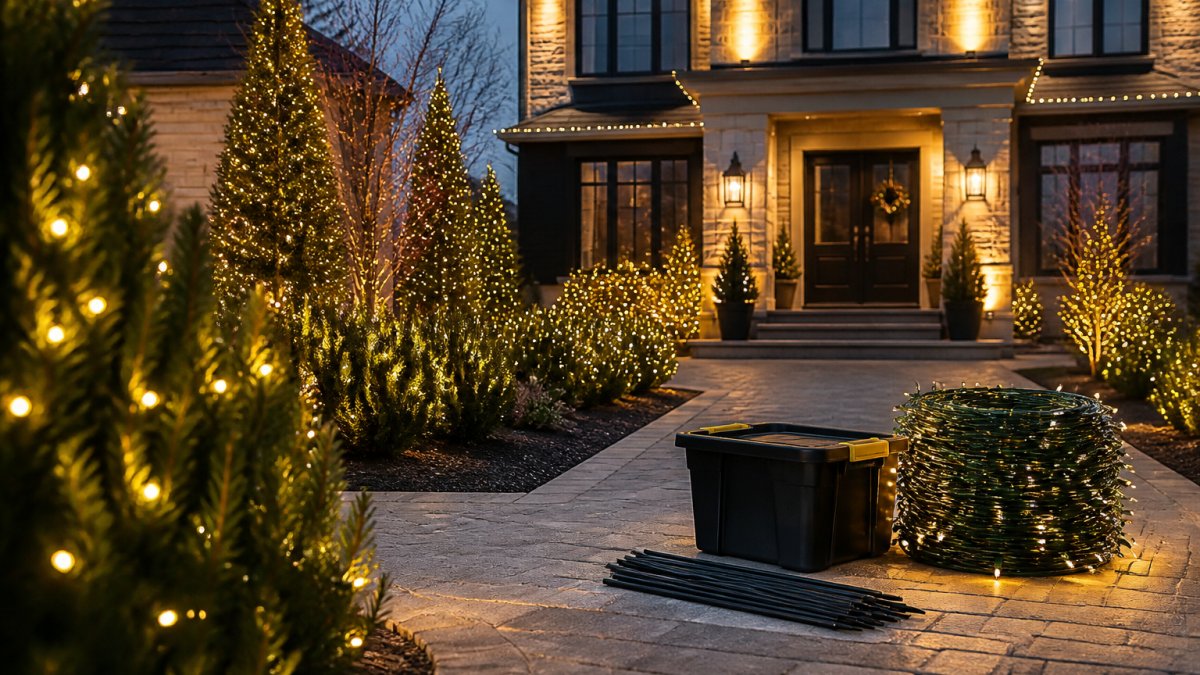
Lighting is the most powerful tool in your seasonal decor toolkit, transforming a storefront after dark with drama plain decorations can't match. The key is balance: too much looks chaotic, too little looks dim. Strategic placement creates a welcoming glow without overwhelming the space.
Where to focus your lighting:
- Entryway and door frame: Light the entrance so customers feel welcomed and safe approaching your store.
- Window displays: Uplighting or spotlighting highlights merchandise and creates depth.
- Architectural features: Light the roofline, corners, or facade to define the storefront's shape.
Warm white lights feel welcoming; cool white feels modern and energetic. Choose based on your brand, and stay consistent, mixing tones looks accidental.
Creating Seasonal Window Displays That Stop Foot Traffic
Your window display is a conversation starter, the first thing potential customers see, and it determines whether they pause or keep walking.

How to build a window display that works:
- Start with a focal point: A large wreath, a dramatic lighting element, or a standout seasonal piece should anchor the display. Everything else supports it.
- Use color intentionally: Stick to 2-3 coordinated colors. Too many colors feel scattered. A cohesive palette looks deliberate and professional.
- Create depth: Layer elements at different heights and distances from the window. This creates visual interest and prevents the display from looking flat.
The best displays are also easy to update: modular elements like removable garlands, swappable planters, and flexible lighting let you refresh without a full overhaul each season.
Retail Store Curb Appeal Ideas Using Wreaths, Garlands, and Planters
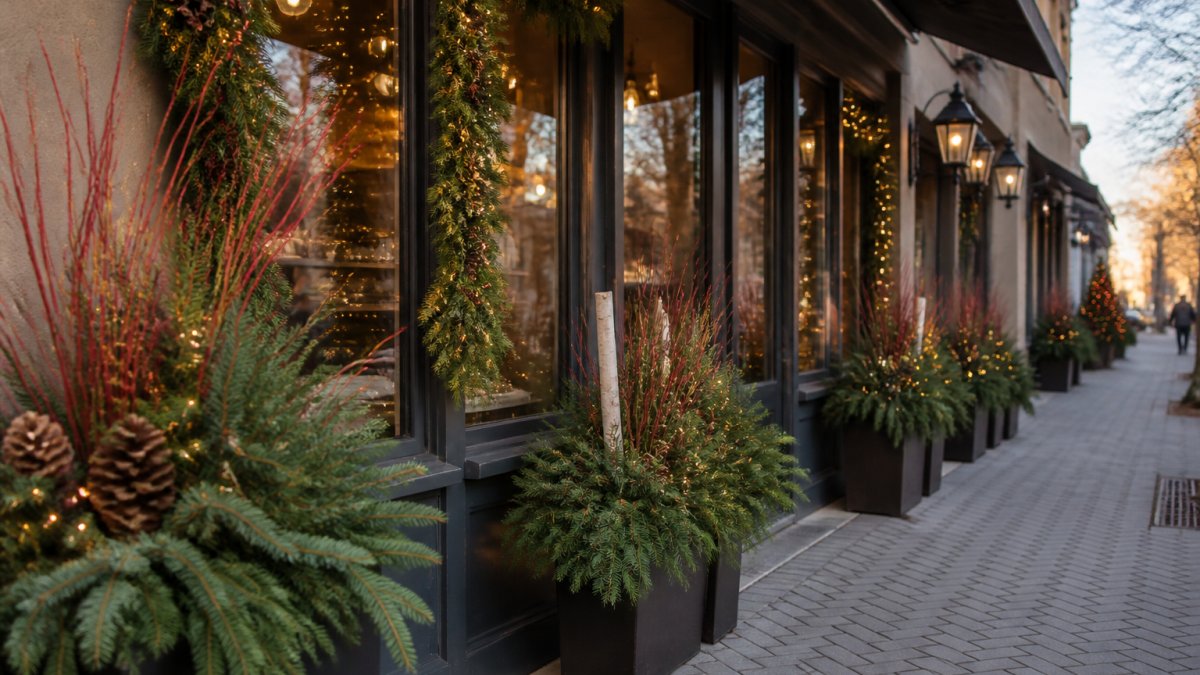
Wreaths, garlands, and planters are the workhorses of seasonal retail decor.
Wreaths create an immediate focal point. Hang them on doors, above windows, or on the facade itself.
Garlands add volume and drama. Drape them along railings, around door frames, or across the storefront's upper edge.
Planters anchor the entryway and soften hard architectural lines. Pair planters on both sides of the door for symmetry.
The key to all three is repetition with variation: two matching planters feel intentional, four of varying heights create interest, and multiple wreaths at different scales feel coordinated. Material quality matters too, faded or damaged decor signals neglect, while high-quality materials communicate that your business cares about details.
Holiday Landscaping Ideas for Businesses: Budget and Reuse Strategy
Holiday landscaping doesn't require a massive budget if you plan for reuse.
Build your display in three cost layers:
- Permanent structure (year-round): Planters, mounting hardware, built-in fixtures, and architectural lighting. These are bought once and amortized across many seasons. They set the frame every display hangs on.
- Seasonal layer (changes each season): Greenery, garlands, wreaths, flowers, and seasonal lighting. This is where most of the visual change happens, and where reusable artificial pieces earn their keep.
- Accent layer (refreshed often): Ribbons, branches, small decorative pieces, and signage. These are inexpensive to swap and are the fastest way to make a reused display feel new.
This layering is the core budgeting mechanism: spend on permanent structure once, invest in durable seasonal anchors, and keep the accent layer cheap and flexible.
Smart sourcing strategies:
- Invest in quality anchor pieces: A durable wreath, high-end garland, or professional-grade planter lasts multiple years. These are worth the upfront cost because they carry the display season after season.
- Buy seasonal fillers fresh: Flowers, branches, and greenery are inexpensive when bought seasonally. Use them to refresh anchor pieces each year.
- Mix real and artificial: Real evergreens and flowers create authenticity. Artificial elements fill gaps and extend the life of displays. A common pattern is real greenery at eye level and artificial where it's hard to reach or replace.
Storage that actually protects the investment:
- Store wreaths flat or in dedicated wreath bags, not stacked, so they keep their shape.
- Coil garlands loosely around a large form rather than stuffing them into bins; crushing breaks the wire and flattens the foliage.
- Label bins by season and location so installation crews pull the right pieces without sorting.
Reuse versus replace: a simple decision rule:
- Reuse anything structural, anything with intact wiring and hardware, and anything whose color still matches your brand palette.
- Replace anything faded, crushed, rusted, or unsafe. Faded or damaged decor signals neglect, and a display that looks tired undercuts the whole investment.
- Refresh the accent layer every season even when the anchors are reused. New ribbon and a few fresh elements make a reused display read as new.
Proving the investment paid off:
Treat the decor budget like any marketing spend and tie it to outcomes: track foot traffic before and after installation, watch conversion rate and average transaction value, and note customer comments and social shares.
Safety, Maintenance, and Weather Resistance for Seasonal Displays
A beautiful display that falls apart in the first rainstorm damages your brand, so durability and safety are non-negotiable.
Weather resistance starts with installation:
- Secure all elements firmly; wind, rain, and temperature swings stress fixtures and materials.
- Use weather-resistant hardware, stainless steel, galvanized steel, or marine-grade fasteners resist rust.
- Protect electrical connections: all outdoor lighting should be GFCI-protected and sealed against moisture.
Real evergreens need water, especially in dry weather. Dried-out branches look sad and create fire hazards if lit.
Artificial materials degrade in direct sunlight. UV-resistant fading happens anyway, but high-quality artificial decor resists it better. Store materials indoors during off-season months to extend their life.
Safety considerations:
- Keep displays away from walkways where they could create tripping hazards.
- Ensure lighting cords are secured and protected from foot traffic.
- Use proper ladders and equipment when installing high elements.
Four Seasons Landscaping NY handles the technical side, proper installation, weather-resistant materials, and regular maintenance. That's what frees you to focus on the visual impact and the business results.
Measuring the Business Impact of Your Seasonal Curb Appeal Investment
Tracking the impact of your seasonal decor tells you what's working and where to invest next.
Metrics that matter:
- Foot traffic: Track customer counts before and after seasonal decor installation. Many retail locations already count customers at the door.
- Conversion rate: Monitor whether more people who enter actually make purchases. Better curb appeal should increase both traffic and conversion.
- Average transaction value: Does seasonal decor attract different customer types? Does it correlate with higher or lower average purchase amounts?
Start with baseline data before installation, then measure again 2-4 weeks after. A visible increase in foot traffic is the clearest sign your investment is paying off. The best strategies combine visual appeal with measurable business impact.
Seasonal decor transforms how customers perceive your retail storefront, but installation, maintenance, and consistent updates require expertise and attention. Four Seasons Landscaping NY specializes in commercial holiday lighting and seasonal decor that combines visual impact with professional durability. Our team handles design, installation, weather-resistant materials, and seasonal maintenance so your storefront stays stunning all year. Get your free quote and let us show you how strategic seasonal decor drives foot traffic and business results.
Frequently Asked Questions
Is seasonal decor worth it for a retail business?
Yes. Seasonal decor directly impacts foot traffic and customer perception. Retail storefronts with thoughtful seasonal displays attract more passersby, create a festive atmosphere that encourages impulse purchases, and signal that your business is active and well-maintained. The investment in seasonal decor typically pays for itself through increased conversion and customer dwell time during peak retail periods.
What is the 3-5-7 rule for decorating a storefront?
The 3-5-7 rule is a visual design principle: use 3 main colors, 5 texture types, and 7 focal points in your display. This creates a cohesive, balanced look that feels intentional rather than cluttered. For retail storefronts, this means selecting a color palette (e.g., gold, green, white), varying materials (evergreens, fabric, metal, wood, glass), and distributing focal points across your entryway, windows, and planters so the eye moves naturally through your facade.
When should a business install and remove holiday decorations?
Begin installation 4-6 weeks before your peak retail season. For holiday shopping, most retailers install in late October or early November to capture early-season traffic. Remove decorations within 2-3 weeks after your busiest period ends to refresh the storefront and prepare for the next seasonal transition. Timing depends on your local customer behavior and foot traffic patterns, track when shoppers are most active in your area.
How can retailers keep outdoor seasonal displays safe and well maintained?
Secure all decorations against wind and weather using appropriate anchors, brackets, and fasteners. Choose weather-resistant materials like artificial evergreens, UV-stable lighting, and treated wood. Inspect displays weekly for loose elements, fading, or damage. Keep electrical connections protected from moisture, and ensure all lighting meets electrical safety standards. Clear debris and snow regularly to maintain visibility and prevent safety hazards around entryways and pedestrian pathways.