 how-to
Commercial Landscaping Curb Appeal Tips for 2026
Table of Contents
- Why Commercial Landscaping Curb Appeal Drives Real Business Results
- ROI and Property Value: What First Impressions Are Worth
- Start With a Site Assessment Before You Spend a Dollar
- Seasonal Commercial Landscaping Ideas That Work Year-Round
- The Benefits of Consolidated Landscaping Services for Property Managers
- Building a Commercial Landscape Maintenance Schedule That Holds Up
- ADA Compliance and Security-Focused Landscaping: What Most Guides Skip
- Low-Maintenance and Sustainable Landscaping for Commercial Properties
- Conclusion
- Frequently Asked Questions
Last Updated: September 10, 2026
Why Commercial Landscaping Curb Appeal Drives Real Business Results
Commercial landscaping curb appeal tips matter most when you understand what's actually at stake: first impressions that happen before a prospect ever walks through your door. At Four Seasons Landscaping NY, we've spent more than 20 years watching how exterior maintenance shapes tenant decisions, customer trust, and lease renewals across Westchester County.
Commercial curb appeal is the combined visual impression a property makes through its landscaping, hardscape, signage, and exterior maintenance. It's the first thing prospects evaluate, often before they read a single listing detail.
That impression carries financial weight. Property managers and owners who treat landscaping as a line item to minimize usually discover the opposite: deferred exterior maintenance shows up in vacancy rates, tenant turnover, and negotiated lease terms. The property that looks cared for commands attention. The one that doesn't gets skipped.
Below, we'll show you exactly how to build a curb appeal program that holds up across all four seasons, and the specific steps that separate properties people notice from ones they drive past.
ROI and Property Value: What First Impressions Are Worth
Landscaping returns aren't abstract. Commercial properties with well-maintained grounds consistently lease faster and retain tenants longer, according to industry analysis from the National Association of Landscape Professionals, because prospects judge management quality by exterior condition.
The logic is simple. A cracked walkway, patchy turf, or faded signage signals that ownership isn't investing. That perception bleeds into lease negotiations. Tenants who feel a property is neglected push harder on rent and concessions.
What most guides miss is that curb appeal compounds. A property that looks sharp in April but ragged by August tells prospects the maintenance is reactive, not planned. Consistency is the asset. Seasonal color, clean hardscape, and trimmed plantings working together throughout the year build the impression that someone is paying attention.
Start With a Site Assessment Before You Spend a Dollar
A site assessment is a structured walkthrough that documents the current condition of every exterior element: walkways, entrances, signage, turf, plantings, irrigation, lighting, and hardscape. It's the step most property managers skip, and it's why budgets get spent on the wrong things.
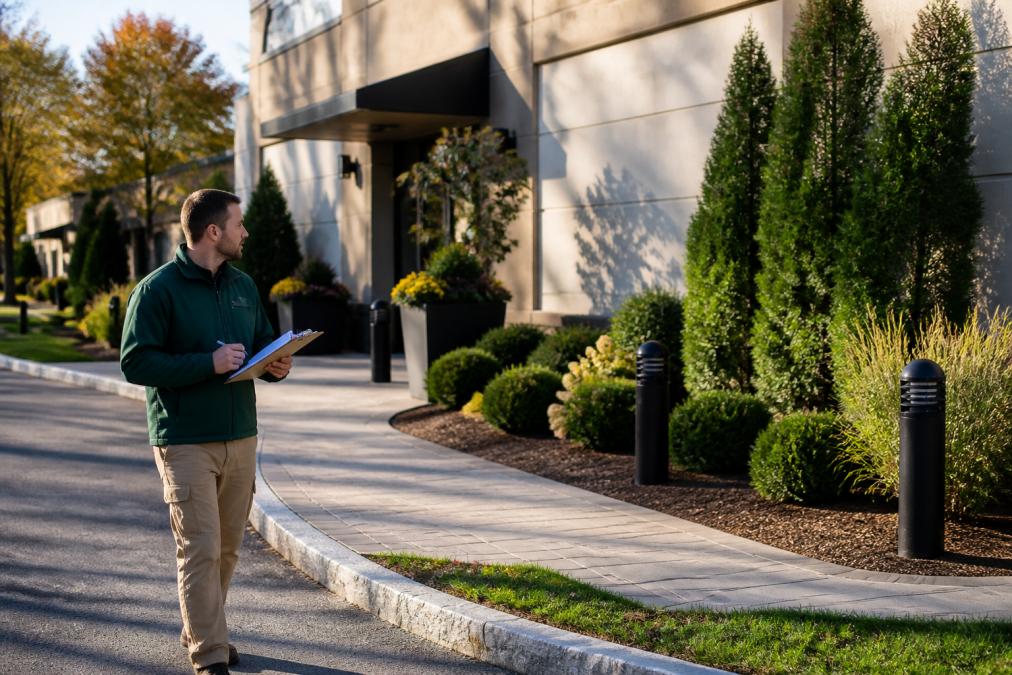
Walk the property during business hours, not after. You need to see foot traffic patterns, where visitors actually enter, and which sightlines matter. Note the condition of each zone and rank it by visibility and foot traffic volume. The entrance and primary walkway get priority. Back-of-building service areas get attention last.
What to Document in Each Zone
A useful assessment produces a written record, not a mental note. For each zone, capture:
- Surface condition: cracks, heaving, trip hazards, faded striping, stained pavers
- Plant health: dead limbs, disease, overcrowding, plants blocking windows or signage
- Irrigation coverage: dry spots, overspray on pavement, broken heads, controller settings
- Lighting: burned-out fixtures, dark pockets, fixtures aimed at the wrong target
- Drainage: standing water, erosion channels, clogged inlets
- Sightlines: what a driver sees from the street and what a pedestrian sees from the sidewalk
Photograph each issue and note its location. A photo log turns a subjective walkthrough into a prioritized work list that survives staff turnover and vendor changes.
Walkways, Entrances, and Signage Visibility
Walkways define how visitors experience a property. Cracked pavers, uneven surfaces, and overgrown edges undermine everything else, no matter how good the plantings look. Repair and edge walkways first.
Entrance design deserves disproportionate investment because it's the single most photographed and remembered element. Signage visibility follows the same rule: if a prospect can't read your sign from the street because a shrub has grown into it, you've lost a marketing asset. Prune around signage on a schedule, not when someone complains.
Time the Assessment to the Season You're Planning For
An assessment done in July won't tell you what the property needs in December. Walk the property at least once per season, and add a dedicated pre-holiday walkthrough in early fall. That walkthrough should answer three questions: where will holiday lighting and décor have the most impact, which fixtures and outlets already exist, and what pruning or cleanup needs to happen before installation crews arrive. Properties that plan holiday lighting during the fall assessment get better placement, fewer change orders, and a calendar slot before the season fills up.
Seasonal Commercial Landscaping Ideas That Work Year-Round
Seasonal commercial landscaping ideas should follow a calendar, not a reaction. The properties that look best in every season are the ones where each phase is planned months ahead. The goal is continuity: a property that looks intentional in April should still look intentional in December.
Spring: Reset and Color
Spring is recovery season. Beds get cleaned out, winter debris is removed, mulch is refreshed to the correct depth, and seasonal color goes in at the entrance and primary walkway. Irrigation systems get started up and checked zone by zone before the first heat wave. This is also the window to repair hardscape damage from freeze-thaw cycles, since crews and materials are easier to schedule before summer demand peaks.
Summer: Heat and Water Management
Summer focuses on irrigation management and turf health under heat stress. Mowing height matters more than most managers realize: cutting too short stresses turf and invites weeds. Irrigation checks should be frequent enough to catch broken heads and dry spots before they show as brown patches. Pruning stays light in summer to avoid stressing plants during peak heat.
Fall: Preparation and Planting
Fall brings leaf removal, aeration, overseeding where needed, and planting for spring bulbs. It's also the best window for structural pruning, since many trees and shrubs respond well to dormant-season cuts. Hardscape repair done in fall protects surfaces through winter freeze-thaw cycles. And fall is when the holiday lighting plan should already be in motion, not just starting.
Winter: Where Most Properties Give Up
Winter is where most commercial properties go dark and drab, and where the biggest opportunity sits. Turf goes dormant, annual color is gone, and the property's visual identity depends almost entirely on hardscape, evergreen structure, lighting, and holiday décor. A property with a strong winter plan looks cared for when competitors look abandoned.
Holiday Lighting and Décor: Extending Curb Appeal Into Winter
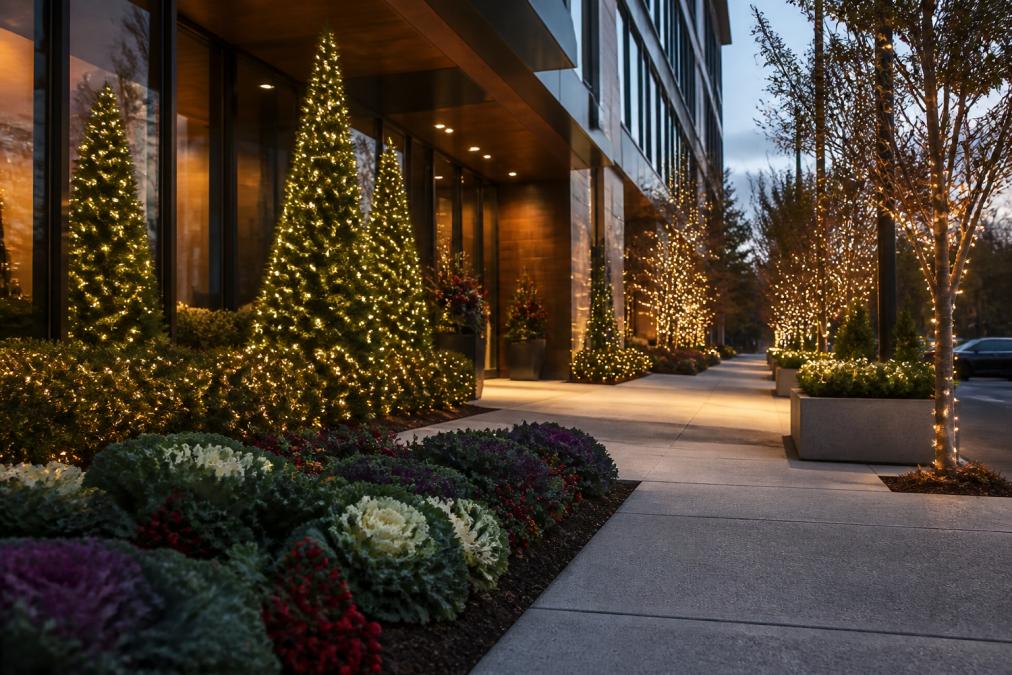
Holiday lighting and décor extend curb appeal into the months when most commercial properties go dark and drab. Well-designed lighting turns an entrance into a landmark, draws foot traffic, and keeps a property looking intentional through the slowest season. For retail and mixed-use properties, holiday lighting is often the single highest-visibility exterior investment of the year.
Design matters as much as installation. A few principles separate a professional holiday display from a tangle of extension cords:
- Match the architecture. Lighting should trace the building's lines and highlight entrances, not fight the structure.
- Layer the look. Combine tree wraps, roofline lighting, ground-level fixtures, and freestanding décor so the display reads well from both the street and the sidewalk.
- Use commercial-grade materials. Consumer-grade strands fail in cold and wet conditions; commercial-grade fixtures are built for outdoor exposure and multi-season use.
- Plan power and safety first. Outlet capacity, GFCI protection, cable routing, and trip-hazard avoidance should be designed before installation day.
- Coordinate with year-round lighting. Holiday lighting that complements existing exterior lighting looks intentional; lighting that duplicates or clashes with it looks improvised.
The mistake is treating holiday lighting as an afterthought booked in December. Properties that book installation early get better design, better scheduling, and better results. Installation calendars fill quickly once the season starts, and the best design and installation windows go to properties that planned in late summer or early fall. If you want your property lit and decorated before the season starts, the time to plan is now.
Four Seasons Landscaping NY handles holiday lighting and décor as part of a full exterior program, so the winter look matches the rest of the year instead of clashing with it. That includes design, commercial-grade materials, installation, maintenance during the season, and takedown and storage after.
The Benefits of Consolidated Landscaping Services for Property Managers
The benefits of consolidated landscaping services come down to accountability. When one provider handles design, maintenance, irrigation, masonry, and seasonal décor, there's no finger-pointing between vendors when something fails.
Property managers typically juggle a maintenance crew, a masonry contractor, an irrigation specialist, and a lighting vendor. Each one blames the others when a walkway floods or a bed dies. Consolidation removes that gap. One team owns the outcome, one point of contact handles scheduling, and one invoice replaces four.
For multi-property portfolios, the operational savings matter as much as the visual consistency. Uniform standards across every site, one relationship to manage, and a provider who already knows your properties.
Building a Commercial Landscape Maintenance Schedule That Holds Up
A commercial landscape maintenance schedule is a written calendar of tasks by season, with assigned frequency and clear responsibility. Without it, maintenance becomes reactive and the property looks it.
| Season | Core Tasks | Frequency | Primary Focus |
|---|---|---|---|
| Spring | Bed cleanup, mulch, seasonal color, irrigation startup | Monthly | Recovery and color |
| Summer | Mowing, turf management, irrigation checks, pruning | Weekly | Heat and water stress |
| Fall | Leaf removal, aeration, planting, hardscape repair | Biweekly | Preparation |
| Winter | Snow management, holiday lighting, structural pruning | On-call plus scheduled | Visibility and safety |
The schedule fails when it's built around the calendar alone. Build it around your property's specific exposures: which beds get full sun, where water pools, which entrances carry the most foot traffic. A schedule that ignores site conditions gets abandoned by mid-summer.
ADA Compliance and Security-Focused Landscaping: What Most Guides Skip
Two topics almost no commercial landscaping guide addresses properly: accessibility compliance and security. Both affect liability, and both are shaped by landscaping decisions.
ADA compliance in landscaping means maintaining accessible routes, clear widths, and stable surfaces as required under the Americans with Disabilities Act (ada.gov). Overgrown plantings that encroach on a walkway, roots that heave pavement, or mulch that softens a path can all create compliance problems. The ADA Standards for Accessible Design set the requirements for accessible routes and surfaces. Review them with your landscaping plan, not after a complaint.
Security-focused landscaping works the opposite way from what most people assume. Dense shrubs against a building create hiding spots and block sightlines. Strategic pruning, lower plantings near entries, and lighting that eliminates dark pockets improve both safety and the perception of safety. Landscaping and outdoor lighting should be designed together, because one determines whether the other actually works.
Low-Maintenance and Sustainable Landscaping for Commercial Properties
Low-maintenance commercial landscaping reduces ongoing labor without sacrificing appearance. The approach starts with plant selection and irrigation design, not with cutting service frequency.
Native plants adapted to local conditions need less water, fewer replacements, and less intervention once established. Sustainable landscaping for commercial properties pairs those plantings with efficient irrigation: drip systems, smart controllers, and zone-based scheduling that waters based on need rather than a fixed timer. Water conservation isn't just an environmental point; it's a cost line that shows up every month.
Mulching deserves more attention than it gets. Proper mulch depth suppresses weeds, retains moisture, and protects roots. Too much mulch, piled against trunks, causes problems. The right depth, refreshed on schedule, cuts maintenance hours across the season.
The trade-off is real: native and low-water plantings can look different from a traditional formal landscape. For properties with strict aesthetic standards, the answer is design, not compromise. A landscape architect can build a native plant palette that still reads as polished and intentional.
Conclusion
The properties that win tenant attention and lease negotiations aren't the ones with the biggest landscaping budget. They're the ones with a plan that holds up in every season, from spring color to winter lighting.
Four Seasons Landscaping NY handles the entire exterior as one program: design, masonry, irrigation, year-round maintenance, and holiday lighting and décor. With more than 20 years of experience and a fully insured crew, we deliver the consistency that commercial properties need and the luxury standard that high-end properties demand.
Get your free quote from Four Seasons Landscaping NY and put a curb appeal program in place before the season starts.
Frequently Asked Questions
What adds the most curb appeal to a commercial property?
The highest-impact improvements are usually clean, well-defined walkways and entrances, healthy turf and garden beds, consistent seasonal color, and clear signage visibility. These elements guide foot traffic, frame your building, and signal that the property is professionally managed. Outdoor lighting and mulching also deliver outsized returns because they improve both daytime and nighttime appearance. A site assessment helps you identify which of these your property needs most before committing budget.
How often should a commercial landscape maintenance schedule include seasonal updates?
A practical commercial landscape maintenance schedule moves through four phases: spring cleanup and mulching, summer irrigation and turf management, fall leaf removal and pruning, and winter lighting, snow management, and hardscape checks. Most commercial properties need weekly or biweekly visits during growing season and monthly checks in winter. Seasonal color rotations, typically two to three per year, keep entrances looking intentional rather than neglected between major holidays.
What are common curb appeal mistakes that hurt commercial properties?
Overgrown shrubs blocking signage, cracked walkways that create liability and look neglected, mismatched planters, and irrigation systems that either flood beds or leave them dry are the most frequent problems. Another common mistake is treating landscaping as a one-time project instead of an ongoing program. Properties that skip fall cleanup or winter lighting lose momentum and start spring from a weaker position, which costs more to correct.
How does professional landscaping affect commercial property occupancy and tenant retention?
Well-maintained grounds shape how prospective tenants and their clients perceive a property before anyone walks through the door. Consistent curb appeal supports higher asking rents, shortens vacancy periods, and reduces turnover because tenants associate the property with professional management. For office complexes and retail centers, attractive entrances and clear walkways also improve foot traffic and customer comfort, which directly supports tenant businesses and makes renewals easier to secure.