 how-to
Seasonal Lawn Care Maintenance Schedule for Rye
Table of Contents
- What a Seasonal Lawn Care Schedule for Rye Actually Involves
- Your Lawn Care Calendar by Month
- The Spring Lawn Care Checklist for Cool-Season Grass
- Decoding Ryegrass: Perennial, Annual, and Cool-Season Mixes
- Fall Lawn Care and Overseeding: Timing, Seed Rates, and Seedling Care
- Watering, Mowing Height, and Fertilization Through the Year
- Hiring a Lawn Care Service: What to Ask Before You Sign
- Common Mistakes That Undo a Good Lawn Care Schedule
- Frequently Asked Questions
Last Updated: October 19, 2026
What a Seasonal Lawn Care Schedule for Rye Actually Involves
A seasonal lawn care maintenance schedule for Rye is a year-round plan of mowing, watering, feeding, and seeding tasks timed to cool-season grass and the local growing cycle.
Here is the first thing most homeowners get wrong: "Rye" in this search usually means the town, not the grass.
Below, we'll show you exactly how to build that calendar, where the season breaks, and which tasks decide whether next spring starts strong or starts patchy.
Your Lawn Care Calendar by Month
A lawn care calendar by month works best when it follows soil temperature and local weather, not the date on the wall. Cool-season grass grows hardest in spring and fall. It slows in summer heat and goes dormant in winter. The table below gives you the at-a-glance plan, and the month-by-month notes that follow explain what triggers each task.
| Month | Main Tasks | Trigger to Act | What to Watch |
|---|---|---|---|
| March | Clean up debris, sharpen blade, first light mowing | Soil dry enough not to clump underfoot | Matted patches, wet soil compaction |
| April | Pre-emergent weed control, light feeding, raise cut | Soil temperature consistently in the mid-50s Fahrenheit | Crabgrass germination, uneven growth |
| May | Regular mowing, spot overseeding thin areas | Active growth, no frost in the forecast | Thatch buildup, weed pressure |
| June | Raise mowing height, deep watering, disease checks | Heat stress or dry spells | Brown patches, humid-stretch disease |
| July | Hold mowing height, water deeply and infrequently | Drought stress in open, sunny areas | Heat dormancy, irrigation coverage |
| August | Monitor moisture, plan fall aeration | Late-summer dry spells | Compacted soil, thinning turf |
| September | Aerate, overseed, feed for root growth | Soil warm, air cooling, rainfall returning | Seed-to-soil contact, germination moisture |
| October | Keep mowing, leaf cleanup, final feeding | Leaves matting over turf | Seedling traffic, leaf cover |
| November | Lower final cut, service equipment | Growth slowing, frost approaching | Drainage problems, salt spray |
| December-February | Stay off wet or frozen turf, plan spring work | Saturated or frozen ground | Winter traffic damage, de-icing spray |
March Through May: Waking the Lawn Up
Spring is cleanup and setup, not a sprint to fertilize. Rake out winter debris, check for matted patches, and sharpen your mower blade before the first cut. Set the mower high for that first pass.
Wait for the soil to dry enough that it does not clump underfoot. Mowing wet turf tears the grass and compacts soil. Hold off on heavy feeding until the lawn is actively growing, and time any pre-emergent weed product to soil temperature rather than a calendar date.
June Through August: Holding Ground in the Heat
Summer is about defense. Raise the mowing height, keep the blade sharp, and water deeply but less often so roots follow moisture downward. Early morning is the best window; evening watering leaves blades wet overnight.
Watch for disease in humid stretches and for drought stress in open, sunny areas. The goal in summer is not growth. It is survival without damage.
September Through November: The Season That Decides Next Year
Fall is the most important stretch on the entire lawn care schedule. Cool air and warm soil push strong root growth and give new seed its best chance.
Do not rush the cleanup. Leaves left matted over turf block light and trap moisture. Keep mowing as long as the grass keeps growing, and lower the height gradually toward the final cut.
December Through February: Dormant, Not Abandoned
Dormant grass is still alive. Stay off saturated turf, because winter traffic on wet soil causes compaction you will fight all spring. Keep salt and de-icing spray off lawn edges and planting beds.
Winter is also planning season. It is also the time to think about Holiday Lighting and Décor, since a display installed before the ground freezes is easier on the lawn than one staked in mid-December.
The Spring Lawn Care Checklist for Cool-Season Grass
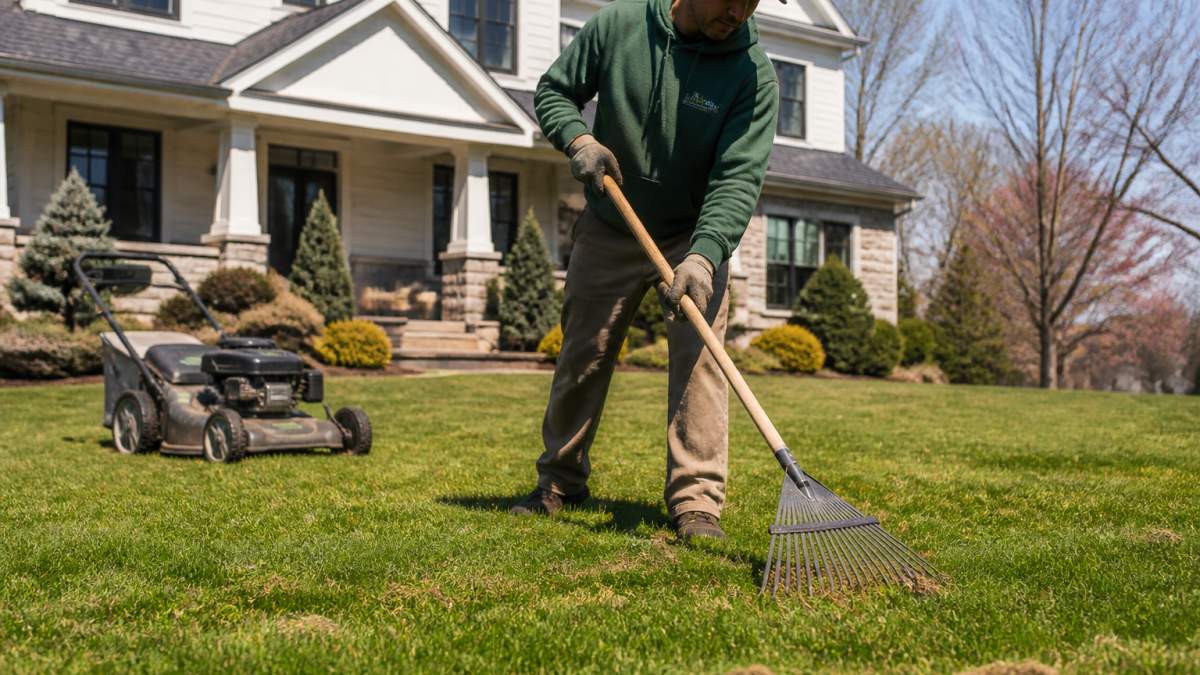
A spring lawn care checklist for cool-season grass covers six jobs, in this order: clean up debris, check soil moisture, sharpen the blade, set a higher cut, address compaction, and handle weeds before they sprout.
Work through it like this:
- Clear leaves, branches, and matted thatch
- Test soil moisture before walking the lawn heavily
- Sharpen or replace the mower blade
Pros of a thorough spring cleanup: fewer disease problems, better seed contact later, cleaner first cut. Cons: it takes a full weekend on a large property, and rushing it on wet ground does more harm than skipping a week.
Decoding Ryegrass: Perennial, Annual, and Cool-Season Mixes
Ryegrass is a fast-sprouting cool-season grass used for quick cover, overseeding, and winter color. There are two main types, and they behave very differently.
Perennial ryegrass comes back year after year. It germinates fast, holds up to foot traffic, and blends well into cool-season mixes.
Annual ryegrass dies out after one season.
Cool-season mixes combine grasses such as perennial ryegrass with fine fescue or Kentucky bluegrass.
What the Species Difference Means for Your Schedule
The species you choose changes four decisions: mowing height, seeding rate, watering through germination, and weed control timing.
- Mowing height: Perennial ryegrass tolerates a range of heights, but a common target is about 2.5 to 3.5 inches during active growth, raised toward the higher end in summer heat. Annual ryegrass for temporary cover can be mowed similarly, but it will not persist.
- Seeding rate: Overseeding rates vary by product and mix. Follow the label, and remember that perennial ryegrass in a mix usually calls for a lower rate per square foot than a pure stand. A common pattern is to apply seed in two passes at right angles for even coverage.
- Watering through germination: Light, frequent watering beats one heavy soaking until seedlings establish. Once seedlings are up, shift to deeper, less frequent watering so roots follow moisture downward.
If You Meant Rye, New York
If your search was for the town rather than the grass, the same schedule applies with a local lens. The growing season is shaped by cool springs, warm and sometimes humid summers, and a fall window that is ideal for aeration and overseeding. The month-by-month calendar above already reflects that pattern. The key local adjustments are to watch soil moisture after heavy rain, because wet soil compacts easily, and to time pre-emergent and seeding to soil temperature rather than a fixed date.
Fall Lawn Care and Overseeding: Timing, Seed Rates, and Seedling Care
Fall lawn care and overseeding succeed or fail on three things: timing, seed-to-soil contact, and watering through germination.
Aerate or lightly scarify first so seed lands in contact with soil, not on top of thatch.
Once seedlings are up, mow high and keep foot traffic light. Do not apply weed control to new seed; most products will harm young grass.
Watering, Mowing Height, and Fertilization Through the Year
Watering, mowing height, and fertilization are the three levers you adjust all year. Change them with the season, not out of habit.
- Watering: deep and infrequent, early morning, adjusted for rainfall
- Mowing height: higher in summer heat, gradually lower in late fall
- Fertilization: light in spring, heavier in fall for root growth
- Mower blade: sharp all season, checked monthly
Soil testing takes the guesswork out of feeding. A basic soil test tells you pH and nutrient levels so you apply what the lawn needs, not what the bag suggests. Many state university extension services offer low-cost soil testing guidance; check your local extension office for current instructions.
Hiring a Lawn Care Service: What to Ask Before You Sign
Hiring a lawn care service comes down to six questions. Ask them before you sign anything, and ask for the answers in writing.
- Is the quote fixed, or can it change mid-season?
- What exactly is included, and what costs extra?
- Who actually shows up, and are they insured?
- How do you handle rain delays and missed visits?
- Do you adjust the plan season by season?
- Can you show work on properties like mine?
Transparent quotes matter most. A low opening number that grows through change orders is not a deal. Ask for the scope in writing, including what triggers an added charge.
At Four Seasons Landscaping NY, we have served Westchester properties for over 20 years as a fully insured, family-owned team. We quote in writing with no hidden fees, and we handle maintenance, irrigation, and seasonal work under one roof.
Common Mistakes That Undo a Good Lawn Care Schedule
Most lawn problems trace back to a handful of avoidable mistakes. Fix these and the schedule starts working.
- Mowing too short, especially in summer heat
- Watering lightly and often instead of deeply and rarely
- Overseeding without opening the soil surface
- Fertilizing in spring and skipping fall
The pattern behind all of them is the same: acting on the calendar instead of the conditions. A lawn care schedule is a guide, not a script.
If you would rather hand the whole calendar to one team, Four Seasons Landscaping NY builds year-round plans around your property, from spring cleanup through fall overseeding and winter prep.
Frequently Asked Questions
When should I stop mowing my lawn in the fall?
Keep mowing until the grass stops growing, which for cool-season lawns in this region usually means late October or into November. Raise the mower setting gradually over the last few cuts so the lawn enters winter a bit taller, which helps it hold up against cold and snow. Don't scalp it on the final cut. If growth has clearly stopped and the mower is just passing over the same height, it's time to put it away for the season.
When should I aerate and overseed?
Late summer to early fall is the window for cool-season grass. Soil is still warm, air temperatures are dropping, and seedlings have weeks of mild weather to germinate and establish before the first frost. Aerating first opens the soil surface so seed makes contact. Water lightly and often during germination, then taper to deeper, less frequent watering once the new grass is established. Overseeding into thin, compacted areas works better than a blanket application over a healthy lawn.
How often should I water my lawn in summer?
Deep, infrequent watering beats daily sprinkling. Aim for about an inch per week, delivered in one or two sessions, so moisture reaches the root zone instead of evaporating off the surface. Early morning is the best time, since evening watering leaves blades wet overnight and invites disease. During hot, dry stretches, let the lawn tell you: if footprints stay visible after you walk across it, it needs water. Adjust for rainfall rather than running a fixed schedule.
When should I hire a lawn care service?
Start the conversation well before the season you need help with, not in the middle of it. Spring cleanups and fall overseeding book up fast, and a provider who can walk the property, check soil conditions, and build a maintenance schedule around your lawn's actual needs will give you a better plan than a crew squeezed into an already full calendar. Ask about insurance, who actually performs the work, and how scheduling changes are handled.
A lawn that looks effortless in June was planned in September. The homeowners who get there are not doing more work; they are doing the right work at the right time, and they are not guessing at soil conditions or seed timing.
If you want that calendar handled by one trusted team, Four Seasons Landscaping NY offers full-service maintenance, irrigation, and seasonal care for Westchester properties. Get your free quote and we will build a plan around your lawn, your soil, and your schedule.