 listicle
Seasonal Outdoor Lighting Design Trends for 2026
Table of Contents
- Why Seasonal Outdoor Lighting Design Is Changing in 2026
- Holiday Outdoor Lighting Ideas That Extend Beyond December
- Landscape Lighting Placement: Where Light Matters Most
- Patio Lighting Ideas for Every Season of Entertaining
- Warm White Outdoor Lighting and the Psychology of Seasonal Mood
- Smart Controls, Automation, and Seasonal Lighting Schedules
- Weatherproofing and Maintaining Your Outdoor Lighting Year-Round
- Conclusion: Planning Your Seasonal Lighting Calendar
- Frequently Asked Questions
Last Updated: October 12, 2026
Why Seasonal Outdoor Lighting Design Is Changing in 2026
Seasonal outdoor lighting design trends in 2026 point toward one clear idea: lighting is no longer a December-only project.
The change is practical. Lighting that stays up and stays beautiful through winter, spring, summer, and fall delivers more value than a display that comes down on January 2. It also protects the investment.
Below, we break down the trends shaping 2026 and show you how to plan a lighting calendar that works all year. The homeowners who start planning now are the ones whose properties look best when the holidays arrive.
Holiday Outdoor Lighting Ideas That Extend Beyond December
The strongest holiday outdoor lighting ideas in 2026 share a trait: they are built to outlast the holiday. Instead of draping a house in lights that get boxed up, homeowners are choosing displays that transition naturally into winter ambiance, and the ones who book early are the ones whose properties look best when the season arrives.
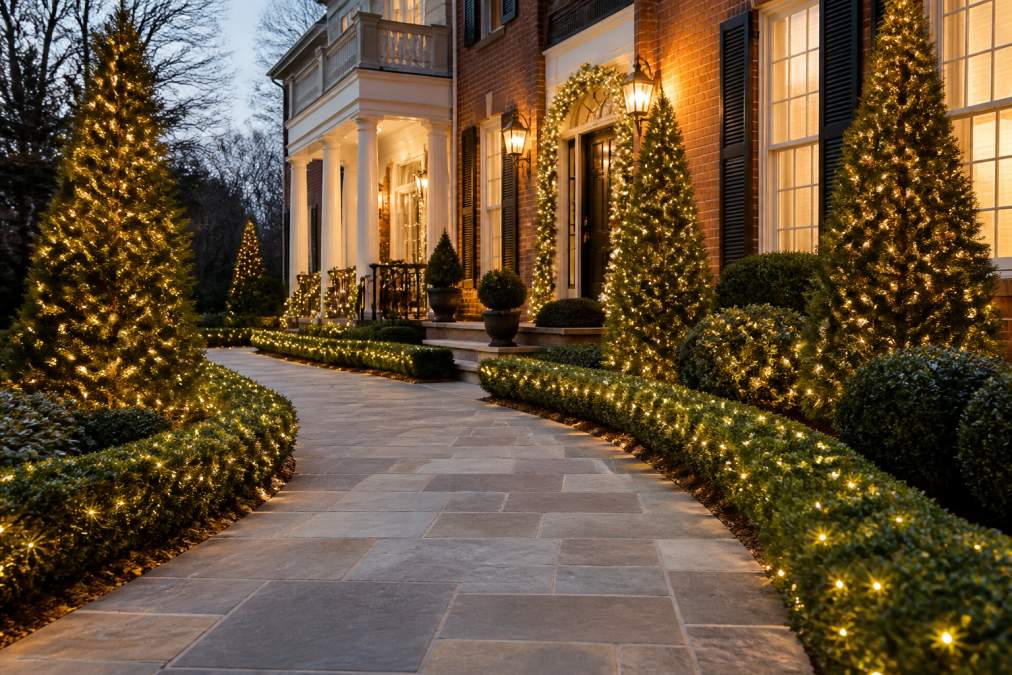
Think about the difference. A roofline lit in warm white looks festive in December and elegant in January. Wrapped trunks and illuminated evergreens read as holiday decor one month and as winter interest the next. The display never looks out of place because it was never purely seasonal to begin with.
A Season-by-Season Holiday and Winter Lighting Calendar
Most guides treat holiday lighting as a single event. A better approach is a calendar that starts before the holidays and carries through the darkest weeks of the year. Here is the sequence most designers follow:
| Window | Focus | What Gets Lit |
|---|---|---|
| Early fall | Anchor points and structure | Rooflines, columns, mature trees |
| Late fall | Holiday layer | Wreaths, garlands, themed accents |
| December | Peak display | Full warm-white and accent scheme |
| January | Transition | Remove themed pieces, keep white structure |
| February-March | Winter ambiance | Lit branches, glowing entry, visible paths |
This sequence is why early planning matters. Homeowners who wait until late November are choosing from whatever is left on the schedule, not from a design built around their property.
Transitioning Holiday Displays Into Winter Ambiance
The transition is simpler than most people expect. Remove the obvious holiday markers, the red and green accents, the themed figures, the wreaths, and leave the white and warm-white structure in place.
What remains is a winter landscape: lit branches against early darkness, a glowing entry, a path that stays visible on long nights. That is ambiance, not decoration, and it holds up until spring planting begins.
Holiday Lighting Design Details That Hold Up
A few concrete choices separate a display that looks designed from one that looks assembled:
- Warm white over cool white. Warm white flatters brick, stone, and wood, and it reads as elegant rather than commercial.
- Wrap, don't drape. Wrapped trunks and branches look intentional in every season; loose draping reads as temporary.
- Light the architecture, not just the shrubs. Rooflines, columns, and entryways carry the design when plantings are bare.
- Keep one accent color, not five. Restraint is what makes a display look high-end.
- Hide the hardware. Concealed connections and matched cord colors are the difference between a display and a tangle.
Landscape Lighting Placement: Where Light Matters Most
Landscape lighting placement decides whether a property looks designed or merely lit. The rule we follow is simple: light what deserves attention, and leave the rest alone.
Most properties need three layers. Ambient light gives general visibility around entries and gathering areas. Task light covers steps, walkways, and driveways where safety matters. Accent light picks out the features worth highlighting.
Where homeowners go wrong is over-lighting. A common mistake is aiming a bright fixture at every tree and shrub, which flattens the whole scene into one flat wash of light. Restraint is what separates a luxury result from a generic one.
Highlighting Trees, Garden Beds, and Architectural Features
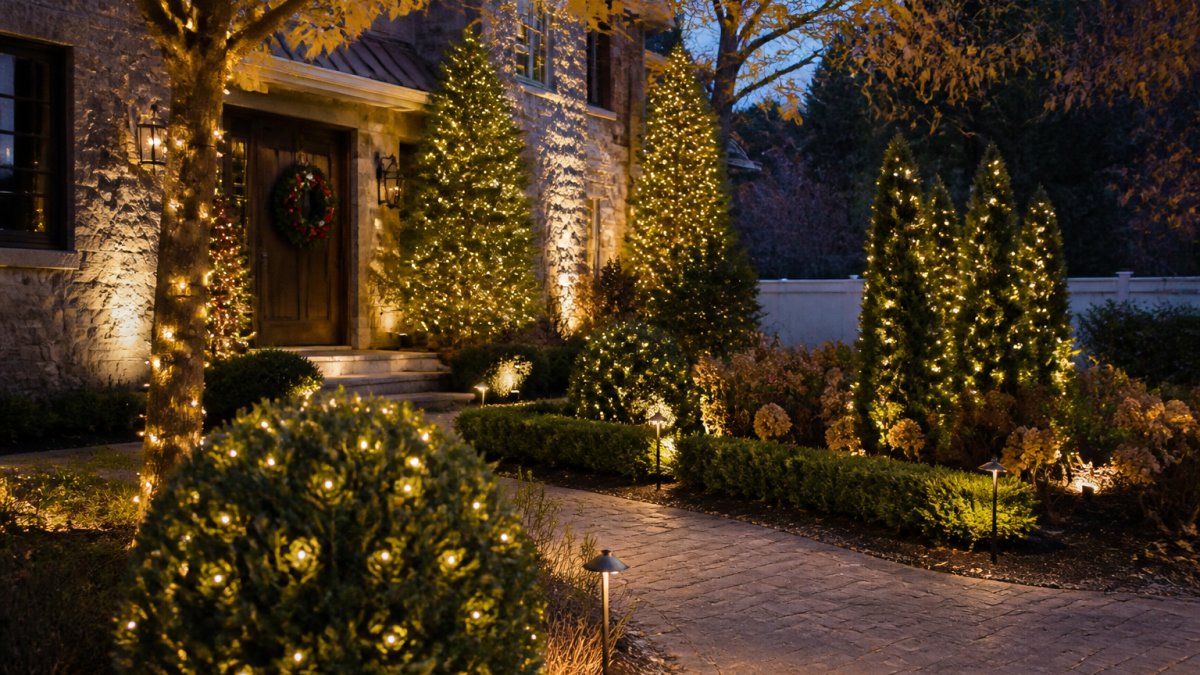
Trees are the backbone of most landscape lighting plans. Uplighting a specimen tree creates a focal point that works in every season, from bare winter branches to full summer canopy.
Garden beds benefit from softer treatment. Ground-wash lighting and in-ground fixtures graze across plantings and low walls, adding depth without glare. Architectural features, stone facades, columns, and masonry walls, respond well to grazing light that reveals texture.
- Trees: Uplight one or two specimens rather than every trunk
- Garden beds: Use ground-wash fixtures for soft, even coverage
- Architecture: Graze stone and brick to show texture
- Pathways: Keep fixtures low and shielded to avoid glare
Patio Lighting Ideas for Every Season of Entertaining
Patio lighting ideas in 2026 lean toward flexibility. The same patio hosts a summer dinner, a fall fire pit night, and a winter gathering under heaters, so the lighting has to change with it.
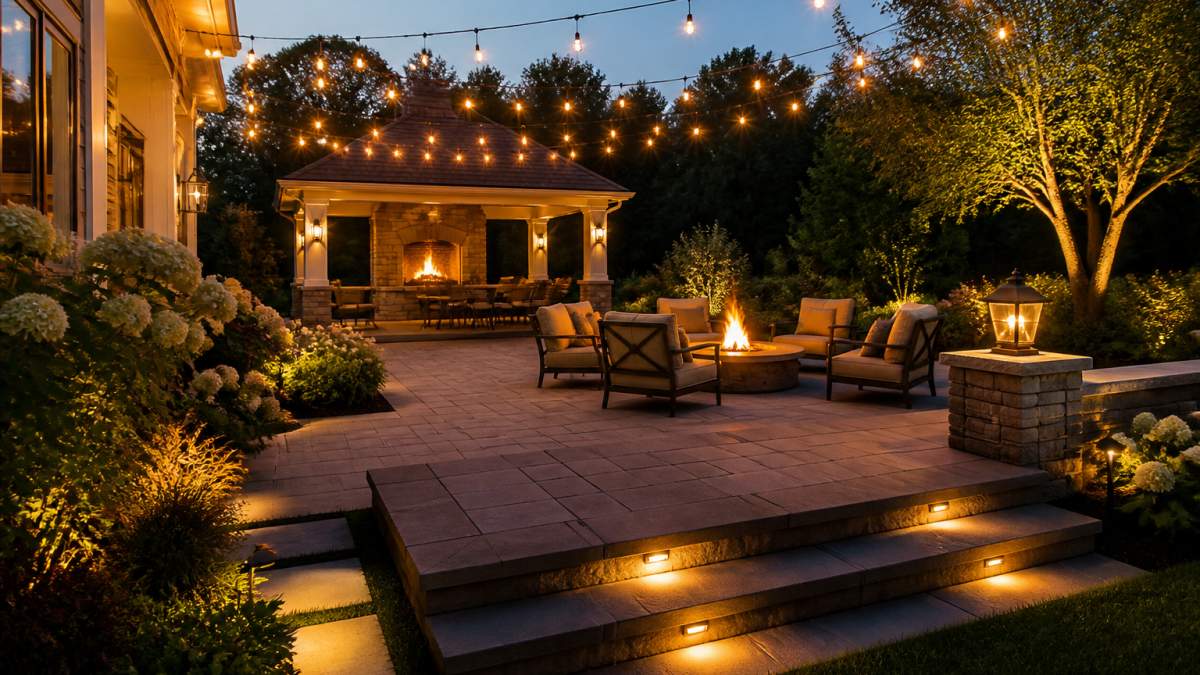
String lights and bistro lighting remain the workhorse for outdoor living spaces. They define a gathering area without walls, and they cast the kind of soft, even glow that harsh spotlights can never match.
The practical move is layering. Overhead string lighting for ambiance, task lighting at the grill and prep areas, and a few accent fixtures on nearby plantings.
Warm White Outdoor Lighting and the Psychology of Seasonal Mood
Warm white outdoor lighting does more emotional work than most homeowners realize. Color temperature changes how a space feels, and the shift between seasons is exactly where that matters. Most trend roundups mention color-changing lights without explaining how to choose a temperature, which is the decision that actually shapes the result.
Color Temperature, Explained Simply
Color temperature is measured in Kelvin (K), and for residential exteriors the useful range is narrow:
| Kelvin Range | Appearance | Best For |
|---|---|---|
| 2200K-2700K | Warm amber to soft white | Fall and winter, brick and wood, cozy entries |
| 2700K-3000K | Warm white | Year-round default for most homes |
| 3000K-3500K | Neutral white | Summer patios, modern architecture, clean lines |
| 4000K+ | Cool white | Commercial settings; rarely flattering on homes |
A common pattern is that homeowners default to whatever the fixture ships with, then wonder why the result feels harsh. Matching the temperature to the material and the season is what makes a system feel intentional.
Warm Versus Cool: When to Use Each
Cooler light reads as crisp and modern, which suits summer evenings and clean architectural lines. Warmer light reads as cozy and welcoming, which is why it dominates fall and winter.
This is where color-changing lights earn their place. A fixture that shifts from a bright neutral white in summer to a warm amber in winter gives you two completely different moods from one system.
What most guides miss is that warm white is not a compromise. It is the default for residential exteriors for a reason: it flatters natural materials, stone, wood, and brick, in a way cooler light simply does not.
A Simple Seasonal Color Temperature Plan
If you want one rule to follow, use this:
- Spring: 2700K-3000K to complement new growth and softer evenings
- Summer: 3000K-3500K for patios and entertaining areas
- Fall: 2200K-2700K to warm up early dusk and highlight foliage
- Winter: 2200K-2700K for holiday displays and long nights
Why This Matters for Holiday Lighting
Holiday displays live or die on color temperature. A roofline in cool white can look sterile against a brick facade; the same roofline in warm white looks rich and inviting. If your holiday lighting is part of a year-round system, choosing the right temperature now means the display transitions cleanly into winter ambiance instead of looking like a separate, temporary install.
Smart Controls, Automation, and Seasonal Lighting Schedules
Smart controls turn a seasonal lighting plan from a chore into a schedule. Once fixtures are on a controller, you can set different scenes for different months and stop thinking about it.
A simple seasonal schedule looks like this:
| Season | Scene | Timing |
|---|---|---|
| Winter | Warm white, holiday accents | Early dusk to late evening |
| Spring | Soft white, garden accents | Dusk to mid-evening |
| Summer | Neutral white, patio focus | Dusk to late night |
| Fall | Warm amber, path and entry | Early dusk to mid-evening |
Automation also handles the details people forget. Timers adjust as sunset shifts through the year. Motion sensors brighten pathways only when someone approaches. Dimmers let you soften the whole system for a quiet evening or brighten it for a party.
For homeowners managing a large property, this is the difference between lighting that runs itself and lighting that needs constant attention. It also reduces energy waste, since fixtures run only when and where they are needed.
Weatherproofing and Maintaining Your Outdoor Lighting Year-Round
Weatherproofing is what keeps a lighting investment alive past the first winter. Exterior fixtures face rain, snow, freeze-thaw cycles, and summer heat, and the ones that fail early almost always fail at the connections.
A few habits protect the system:
- Check and reseal fixture connections before winter
- Clear snow and ice from fixtures and low path lights
- Trim plantings away from fixtures so they are not buried
- Inspect for water intrusion after heavy storms
- Test the controller and timers at each season change
Fixtures rated for outdoor use handle weather far better than indoor fixtures moved outside, which is a mistake we see often. The other common error is skipping maintenance until something stops working. A short seasonal check catches loose connections and cracked lenses before they become replacements.
Conclusion: Planning Your Seasonal Lighting Calendar
The homeowners who get the most from their outdoor lighting are the ones who plan it as a calendar, not a purchase. Winter warmth, spring softness, summer flexibility, and fall amber, all handled by one well-designed system with controls that adjust on their own.
That kind of planning takes experience with how light behaves on a specific property, in every season.
Get your free quote from Four Seasons Landscaping NY and start your seasonal lighting calendar before the holidays arrive.
Frequently Asked Questions
What are the latest trends in outdoor landscape lighting?
The biggest shifts for 2026 include warm white LED systems that mimic candlelight, layered lighting that combines ambient, task, and accent sources, and smart controls that adjust brightness and color temperature by season. Homeowners are also moving toward minimalist fixtures and natural materials that disappear into the landscape during daylight hours. Color-changing options remain popular for holidays and special events, while everyday lighting stays soft and understated.
How do you design outdoor lighting for different seasons?
Start with a year-round foundation of pathway and architectural lighting, then layer seasonal elements on top. Spring and summer call for patio and garden accents that support outdoor entertaining. Fall benefits from amber-toned highlights on trees and entryways. Winter relies on warm white holiday displays and extended evening hours. Smart schedules let you shift brightness and timing as daylight changes, so your property always looks intentional rather than static.
What outdoor lights work best for holiday decorating?
Warm white LED strings remain the standard for holiday displays because they are energy-efficient, durable in cold weather, and flattering against brick, stone, and evergreen branches. For rooflines and trees, commercial-grade clips and timers prevent mid-season failures. If you want flexibility, color-changing LEDs let you shift from traditional white in December to festive colors for other celebrations without rewiring. Professional installation ensures safe connections and even coverage.
Can outdoor lighting be used year-round?
Yes, and it should be. A well-designed system uses durable fixtures rated for your climate and a layout that works in every season. Pathway lights guide guests through winter, patio lighting supports summer dinners, and accent lights highlight trees and architecture all year. The key is choosing fixtures with proper weather ratings and setting schedules that adjust with daylight hours. Many homeowners find year-round lighting improves both safety and curb appeal.