 ultimate-guide
Holiday Lighting and Décor: A Complete Planning Guide
Table of Contents
- Holiday Lighting and Décor Fundamentals
- Outdoor Holiday Lighting Ideas That Transform Your Property
- Holiday Lighting Design: Creating Cohesive, Intentional Displays
- Holiday Light Safety Tips Every Property Owner Should Know
- Professional Holiday Light Installation: When to Call the Experts
- Planning Your Holiday Lighting Timeline and Budget
- Seasonal Storage and Year-Round Maintenance
- Frequently Asked Questions
Last Updated: October 12, 2026
Holiday Lighting and Décor Fundamentals
Holiday lighting and décor transforms your property, creating an inviting atmosphere that reflects your style and enhances curb appeal. Whether residential or commercial, the fundamentals stay the same: intentional planning, quality materials, and proper execution.
At Four Seasons Landscaping NY, we've worked with luxury homeowners and business owners throughout the region to create cohesive displays that last the entire season.
Your property's architecture, landscaping, and existing features determine the best approach. A Victorian home calls for different lighting than a modern minimalist design, and a commercial storefront has different goals than a residential entry. Understanding these distinctions helps you enhance rather than compete with your property's character.
Outdoor Holiday Lighting Ideas That Transform Your Property
Outdoor spaces offer the most dramatic opportunities for holiday lighting and décor, reshaping how your property looks at night and creating visual interest from the street.
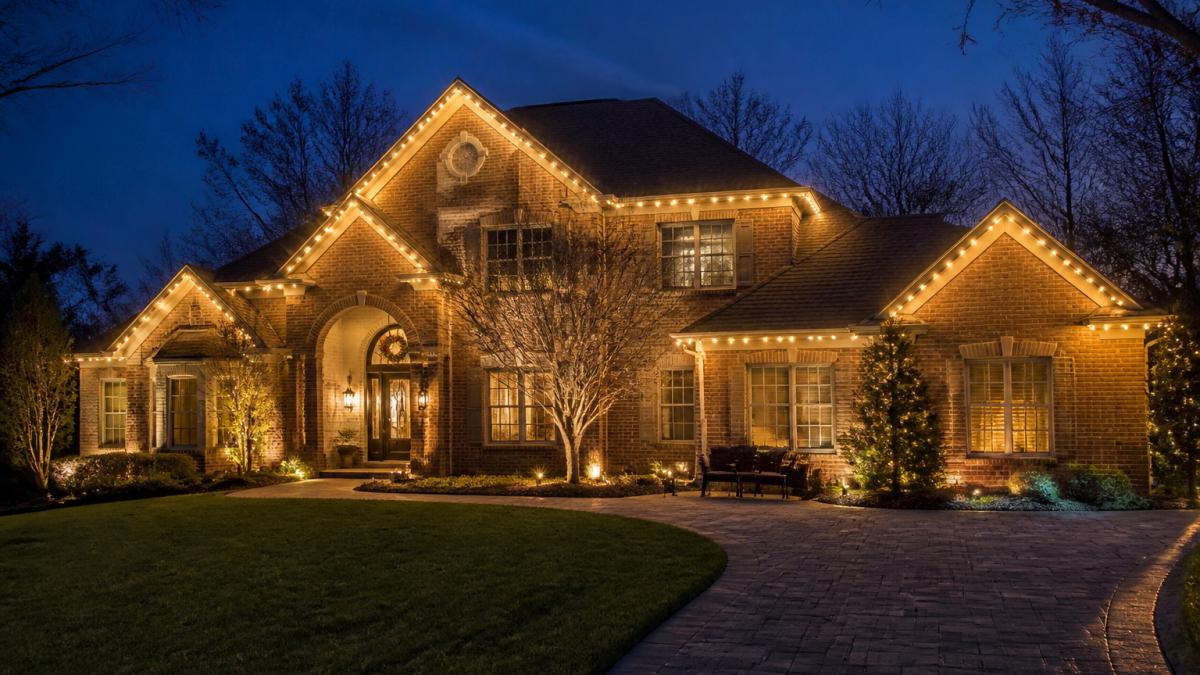
Roofline and architectural framing creates the foundation of most outdoor displays.
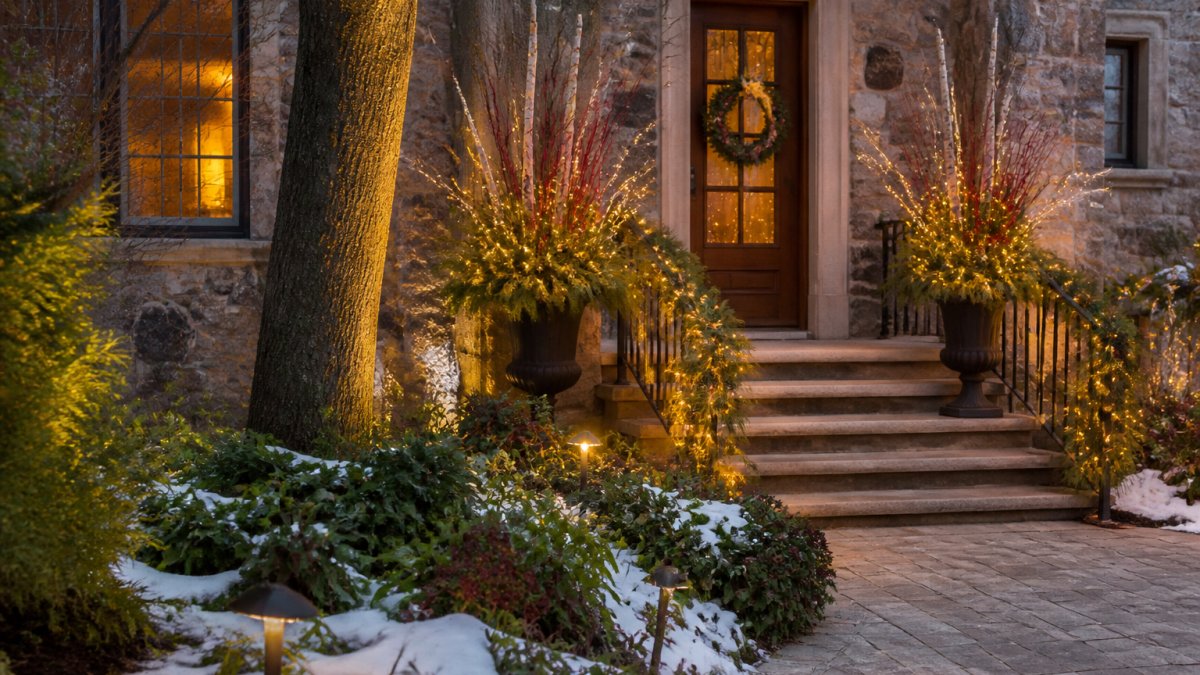
Pathway and entryway lighting serves both aesthetic and practical purposes. Uplighting trees and shrubs adds dimension, while pathway markers create visual flow and improve safety.
Window and door treatments frame your home's openings with light. Rope lights, lit garland, or net lights across window panes create visual interest inside and out.
Ground-level accent lighting highlights landscape features you want to emphasize.
Holiday Lighting Design: Creating Cohesive, Intentional Displays
The most impactful holiday lighting and décor combines multiple techniques into a unified design across your entire property.
Color Temperature and Coordinated Aesthetics
Color temperature describes whether your lights appear warm (yellowish, around 2700K) or cool (bluish-white, around 5000K or higher). This single choice dramatically affects your display's overall aesthetic.
Warm white lights create a traditional, inviting atmosphere that complements traditional architecture, which is why many luxury homeowners prefer them for residential displays.
Cool white and daylight-temperature lights create a modern, crisp aesthetic that suits contemporary homes and commercial properties.
The critical mistake is mixing color temperatures without intention; a display combining warm and cool lights without clear design logic looks confused.
Residential vs. Commercial Display Approaches
Residential holiday lighting and décor prioritizes personal expression and an inviting home environment, enhancing your property's character while reflecting your family's holiday spirit. Residential displays feel warmer and less uniform than commercial installations.
Commercial properties require different thinking. Business holiday lighting and décor serves marketing and branding purposes: a storefront, office building, or restaurant uses it to attract customers, create an inviting entrance, and show community engagement. Commercial displays emphasize consistency, professional appearance, and brand alignment.
The technical requirements differ too. Commercial properties typically need higher-capacity electrical systems, stronger weatherproofing, and faster installation timelines, and safety compliance becomes more critical with higher foot traffic and liability considerations.
Holiday Light Safety Tips Every Property Owner Should Know
Safety is the part of holiday lighting and décor most guides skip, and it causes the most expensive problems. Nearly every failure mode is predictable and preventable once you understand the mechanism.
Electrical Load: Do the Math Before You Plug In
Every household circuit has a maximum capacity, and exceeding it is the most common cause of holiday lighting problems. In the U.S., a standard residential branch circuit is rated at 15 or 20 amps at 120 volts. The widely used guideline, echoed by the National Fire Protection Association (NFPA) and the U.S.
Incandescent mini-lights draw noticeably more current per string than LED equivalents, often several times more for the same visual output, so a single 15-amp circuit can safely carry many more LED strings before approaching the 80% threshold. The exact figure depends on the wattage printed on each string's tag, so read the tag rather than guessing.
Outdoor Ratings, GFCI, and Cord Selection
Outdoor holiday lighting and décor should use fixtures and extension cords marked for outdoor use. Look for a "W" suffix on cord jackets (for example, SJTW or SJEOW), which indicates the jacket is rated for wet locations and exposure to sunlight and cold.
Any outdoor outlet feeding holiday lighting should be protected by a ground-fault circuit interrupter (GFCI).
Keep every connection off the ground. Elevate plugs on a brick, stake, or purpose-made cord elevator so melting snow and rain drain away rather than pooling. Wrap exposed connections with a weatherproof cover or outdoor-rated electrical tape, and point the open end downward so water cannot travel into it.
Ladders, Roofs, and Working at Height
Falls are the injury most associated with holiday decorating. A few habits dramatically reduce risk:
- Use a fiberglass ladder near power lines and service drops; aluminum conducts.
- Maintain three points of contact and keep your belt buckle between the rails.
- Never stand on the top two rungs of a stepladder.
- Set the ladder on level ground and use a spotter when working near the roofline.
- Stay at least 10 feet away from overhead power lines, this is the distance the Occupational Safety and Health Administration (OSHA) uses for unqualified workers near energized lines.
Fastening Without Damaging Your Property
How you attach lights matters as much as what you attach. Adhesive-backed clips can pull paint or siding in cold weather, and nail-in or staple-in fasteners can pierce insulation and create a shock or fire hazard. Use clips designed for the surface, gutter clips for gutters, shingle tabs for asphalt roofs, magnetic clips for metal trim, so nothing penetrates the string or the building envelope.
Weekly Inspections During the Season
Wind, ice, and freeze-thaw cycles loosen connections and stress fasteners. A short walk-around every week or two catches the three failure modes that matter most: a plug that slipped into a puddle, a released clip leaving a string hanging, and a section gone dark (often the first sign of a moisture-damaged connector). Fixing these early prevents outages and hazards.
Professional Holiday Light Installation: When to Call the Experts
Many property owners install holiday lighting and décor themselves, but certain situations make professional installation the smarter choice.
Complex designs requiring precise execution benefit from professional expertise.
Safety-critical installations, particularly those involving electrical work or high-altitude placement, belong in professional hands. Working at height, managing electrical connections, and ensuring proper load distribution require specific expertise.
Time constraints often make professional installation practical.
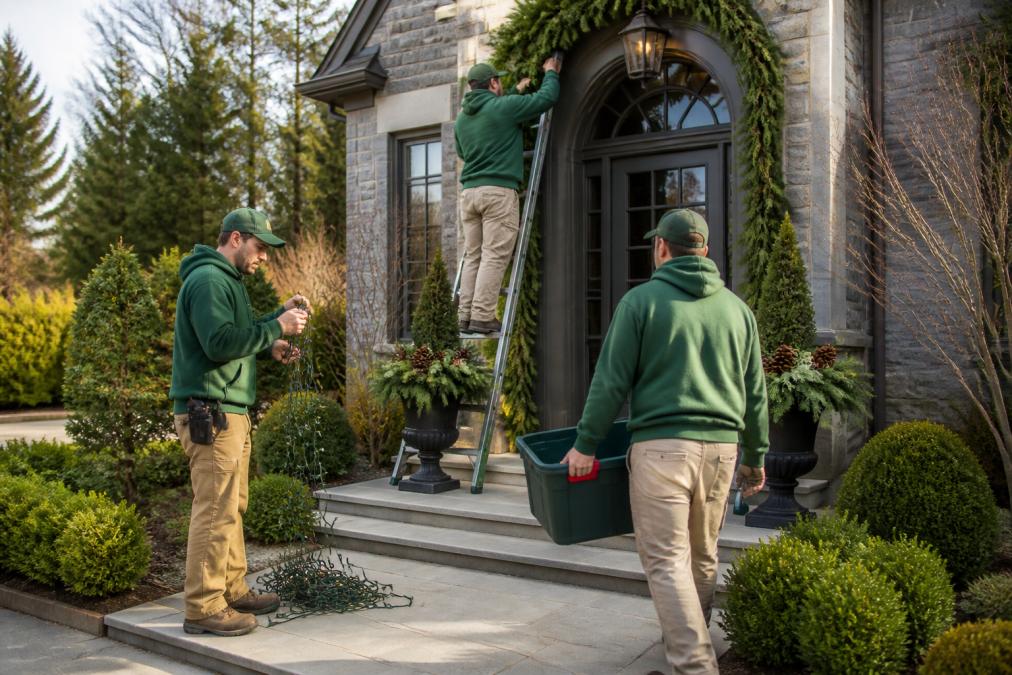
Four Seasons Landscaping NY handles holiday lighting and décor installation for properties throughout the region, managing everything from design consultation through installation and seasonal takedown.
Planning Your Holiday Lighting Timeline and Budget
A holiday lighting and décor project that runs smoothly is almost always scheduled backward from the date the lights need to be on. This timeline reflects how professional installers sequence a season, and it works just as well for a DIY display.
A Month-by-Month Planning Timeline
September, Design and scope. Decide what to light: rooflines, trees, pathways, windows, wreaths, garland, and freestanding décor.
Early October, Source materials and book installation. Order strings, clips, cords, timers, and custom-cut pieces.
Late October, Install the structural elements. Roofline runs, tree wraps, and high-altitude work go up first, while the weather is workable and before the ground freezes.
Thanksgiving week, Full test and photo. Run the entire display on its final timer schedule for one full evening.
December, Maintain, don't install. Be in maintenance mode by December 1.
What Actually Drives the Cost
Holiday lighting and décor costs vary widely, but the drivers are consistent:
- Linear feet of lighting. Rooflines, tree wraps, and pathway runs are priced by the foot. A two-story roofline with multiple gables can require several times the string count of a single-story ranch.
- Height and access difficulty. Work above the first story, steep roof pitches, and obstructions (dormers, chimneys, mature trees) increase labor time and equipment needs.
- Light type. LED strings cost more up front than incandescent but draw far less power and last many seasons, changing total cost of ownership over several years.
- Custom versus off-the-shelf. Custom-cut strings and commercial-grade fixtures cost more but fit architecture cleanly and survive weather better.
- Electrical work. Adding a dedicated outdoor circuit or GFCI protection is a one-time cost that often unlocks a larger display.
- Service scope. Design-only, install-only, and full-service (design, install, maintain, take down, store) are three different products. Full-service costs the most per season but removes every labor hour from your plate.
DIY Versus Professional: An Honest Trade-Off
DIY makes sense when the display is low to the ground, the runs are short, you already own the ladders and cords, and you enjoy the work.
Professional installation makes sense when the display involves second-story or roofline work, complex layering, commercial requirements, or a hard deadline.
A middle path many property owners choose: install the ground-level and window elements yourself and hire a professional crew for the roofline, tall trees, and electrical work. This captures most of the aesthetic impact at a fraction of full-service scope.
Seasonal Storage and Year-Round Maintenance
Proper storage extends the life of your holiday lighting and décor significantly. Lights and decorations stored carelessly often fail the following season.
Before storing, inspect everything carefully.
Organize storage strategically. Label boxes by location and light type so you remember where each element goes when you reinstall.
Climate-controlled storage protects materials better than unheated garages or sheds, where temperature swings and moisture degrade electrical components and decorative elements.
Year-round maintenance includes checking storage periodically and testing lights before the next season arrives.
Creating beautiful holiday lighting and décor requires balancing aesthetic vision with practical considerations.
If your holiday lighting and décor vision exceeds what you can handle yourself, or you want professional expertise ensuring perfect results, Four Seasons Landscaping NY brings over 20 years of experience to every project. Our team manages design, installation, and seasonal takedown so you can enjoy the results without the stress. Get your free quote and discover how professional holiday lighting and décor elevates your property this season.
Frequently Asked Questions
How do you plan outdoor holiday lighting for a large property?
Start by assessing your property's architecture and landscape features. Identify focal points like entryways, rooflines, and mature trees. Sketch a rough layout and decide between warm white, cool white, or multicolor lights based on your home's style. Consider electrical outlet locations and extension cord runs. Measure distances to determine how many light strands you'll need. For complex layouts, professional design consultation can ensure balanced, cohesive results without overloading circuits or creating visual clutter.
What are the most important holiday light safety tips?
Always use outdoor-rated lights and extension cords rated for wet conditions. Check cords for damage before installation. Never exceed the maximum load on a single outlet or circuit; most standard outlets safely handle one heavy-duty extension cord with multiple light strands. Secure lights and cords away from foot traffic and water pooling areas. Use GFCI-protected outlets when available. Inspect lights regularly throughout the season for wear. Turn off decorative lighting when you're away or sleeping to reduce fire risk and electrical strain.
When should you install holiday lighting on your property?
Most homeowners install outdoor holiday lighting in late October or early November, giving time before Thanksgiving and well ahead of December events. This timing allows you to troubleshoot any issues before peak holiday season. If you're using professional installation services, booking in September or early October ensures availability before contractors become fully booked. Interior décor can be installed earlier since it's not weather-dependent. Plan takedown for early January, while weather permits and before winter storms complicate removal.
How do you make holiday lighting look cohesive across your entire property?
Choose a single color palette, either warm white, cool white, or multicolor, and stick with it throughout residential displays. Coordinate lighting with existing landscape elements and architectural style; traditional homes suit warm tones and classic designs, while contemporary properties work well with clean lines and cool white or minimalist color schemes. Layer lights at different heights: rooflines, mid-level trees, and ground-level pathway lighting create visual depth. For commercial properties, align holiday lighting with brand colors and existing signage. Avoid mixing too many light types or densities, which creates visual chaos rather than intentional design.