 how-to
Durable Materials for Westchester Outdoor Fireplaces
Last Updated: October 23, 2026
Quick Summary
Choosing durable materials for Westchester outdoor fireplaces means specifying natural stone, exterior-rated mortar, and high-strength concrete, because freeze-thaw cycles are the main reason these structures fail here. The firebox, facing, and foundation each need their own materials, and drainage details matter as much as the products themselves.
- Natural stone such as fieldstone, bluestone, and granite resists freeze-thaw better than most alternatives.
- Brick failures usually start at the mortar, so use exterior-rated mortar and repoint small cracks before winter.
- Wood-burning fireboxes should be lined with firebrick set in refractory mortar.
- Set foundations below the frost line so frost heave does not crack everything above.
- Inspect mortar joints each spring and clear snow and ice from the top and hearth.
Table of Contents
- Why Material Choice Decides Whether Your Outdoor Fireplace Survives Westchester Winters
- Outdoor Fireplace Stone vs Brick: Appearance, Durability, and Repairs
- Fire-Resistant Materials for Outdoor Fireplaces: Firebox, Facing, and Foundation
- Freeze-Thaw, Snow, and Moisture: What Westchester Weather Does to Masonry
- Wood-Burning vs Gas-Burning: How Fuel Type Changes Material Needs
- Outdoor Fireplace Maintenance That Adds Years to the Build
- Questions to Ask an Outdoor Fireplace Contractor Before You Sign
- Frequently Asked Questions
Why Material Choice Decides Whether Your Outdoor Fireplace Survives Westchester Winters
Choosing durable materials for Westchester outdoor fireplaces determines whether your fire feature lasts decades or crumbles within a few seasons.
Westchester's climate is unforgiving to masonry: repeated freezing and thawing, snow sitting against stone for weeks, and spring moisture working into every joint.
Below, we break down outdoor fireplaces by material, component, and fuel type, so you can specify a build that holds up, plus the questions worth asking any contractor before you sign.
Outdoor Fireplace Stone vs Brick: Appearance, Durability, and Repairs
The outdoor fireplace stone vs brick decision comes down to how much maintenance you accept and what look you want. Natural stone costs more up front and needs less repair; brick costs less and asks for more attention over time. Both are proven choices in this region, neither is a mistake as long as the installation is right.
| Material | Appearance | Durability | Typical Repairs | Best For |
|---|---|---|---|---|
| Natural stone | Irregular, organic, one-of-a-kind | High; resists freeze-thaw well when properly set | Repointing, occasional stone reset | Homeowners wanting a custom, high-end look |
| Brick | Uniform, traditional, warm | Good; mortar is the weak point | Repointing, crack repair, mortar replacement | Traditional homes and tighter budgets |
| Steel | Modern, clean lines | Good; needs rust protection | Repainting, rust treatment | Contemporary patios |
| Concrete | Smooth or textured, versatile | Good when high-strength mix is used | Crack filling, resurfacing | Clean, modern designs |
Natural Stone: Fieldstone, Bluestone, and Granite
Natural stone is the most durable facing option for outdoor fireplaces in this climate. Fieldstone, bluestone, and granite all handle moisture and temperature swings better than most alternatives. Fieldstone gives an irregular, rustic look that suits wooded properties; bluestone offers a flatter, more refined surface for caps and hearths; granite is the hardest and holds up to heavy use. For a broader look at material options suited to local conditions, see our guide to hardscape materials for New York properties.
Brick: Traditional Look, Mortar That Needs Watching
Brick delivers the classic fireplace look many homeowners want, and it performs well when specified correctly. The brick itself is rarely the problem, the mortar is. Mortar joints absorb moisture, which expands when it freezes and stresses the joints until they crack and crumble, letting water reach the brick behind. The fix is straightforward: use mortar rated for exterior freeze-thaw exposure, inspect joints every couple of years, and repoint small cracks before winter.
Fire-Resistant Materials for Outdoor Fireplaces: Firebox, Facing, and Foundation
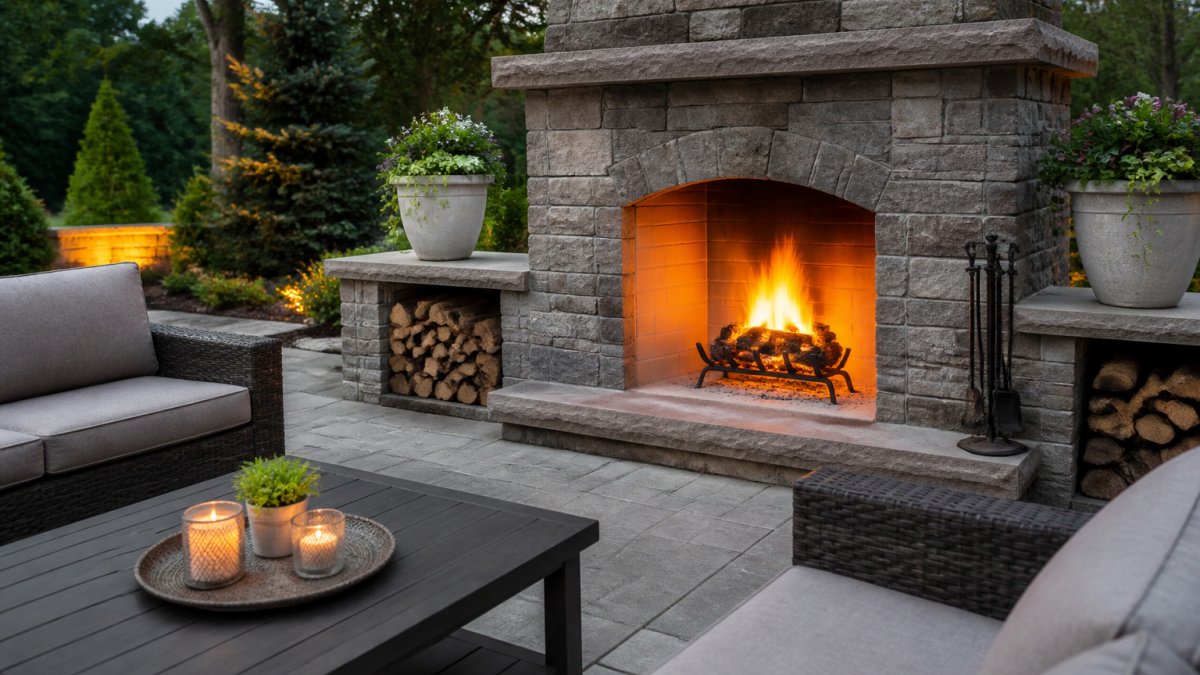
Fire-resistant materials for outdoor fireplaces are not one product but three separate specifications: the firebox, the facing, and the foundation. The firebox takes direct flame and the highest heat, the facing handles radiant heat plus weather, and the foundation carries the whole structure and manages ground moisture. Confusing them is a common and expensive mistake.
Firebox materials: Firebrick and refractory mortar are the standard for wood-burning units.
Facing materials: Stone, brick, and concrete all work as facing when installed with the right clearances and ventilation.
Foundation materials: Poured concrete or high-strength concrete footings set below the frost line keep the structure stable.
For a deeper look at matching materials to custom masonry work, read our article on choosing durable materials for custom masonry.
Steel and Metal Options
Steel and aluminum fireplaces offer a modern look and install faster than masonry. Stainless steel resists rust best; standard steel and aluminum need protective coatings and regular inspection. Metal units are lighter, simplifying the foundation, but they expand and contract more than masonry, so connections and clearances matter. Any exposed metal should be rated for exterior use and checked each spring for corrosion.
Concrete and High-Strength Mixes
Concrete is versatile and, when mixed and finished well, highly durable. High-strength mixes resist cracking better than standard mixes, which matters in a freeze-thaw climate. Poured concrete works for foundations and can form the body of a modern fireplace; the key is curing and reinforcement, since concrete that cures too fast or lacks reinforcement will crack and let water in.
Freeze-Thaw, Snow, and Moisture: What Westchester Weather Does to Masonry
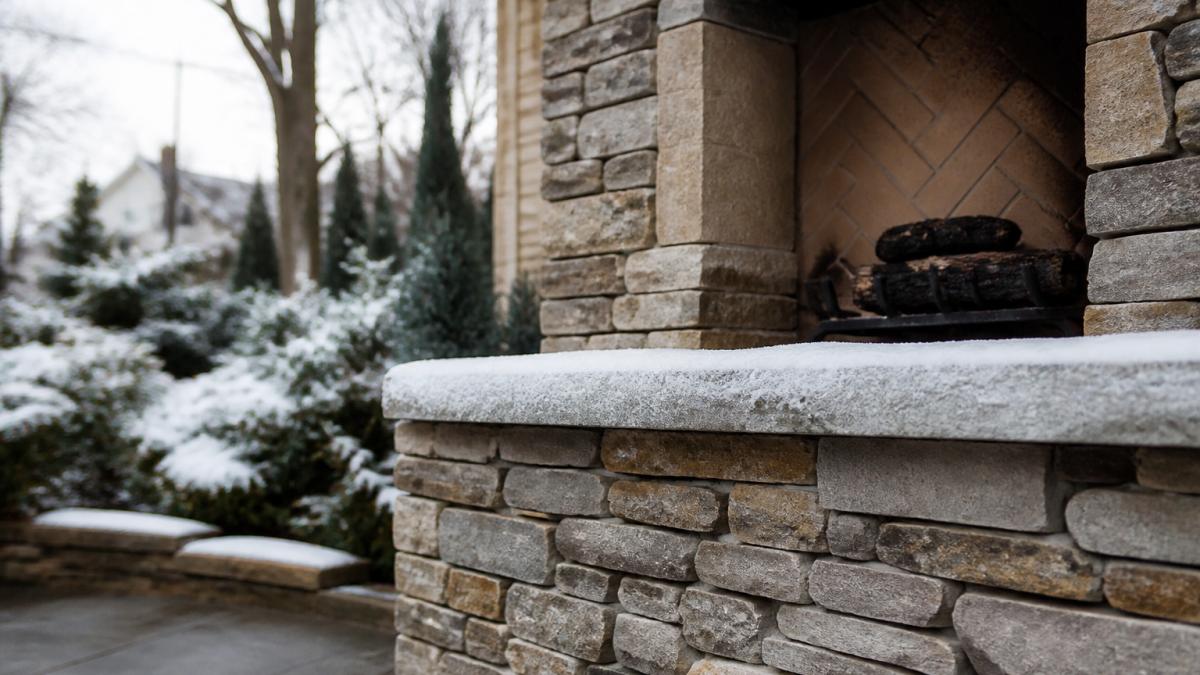
Freeze-thaw cycles are the main reason outdoor fireplaces fail here. Water enters small cracks and pores, freezes, expands by roughly nine percent, and widens them; repeat that through a winter and sound masonry starts to break down.
How Each Material Handles a Winter Here
- Natural stone: Fieldstone, bluestone, and granite are dense and absorb little water, so they resist freeze-thaw well. The weak points are the mortar joints and any trapped water behind the facing. Stone set with a drained cavity and proper flashing outlasts stone set tight against a solid wall.
- Brick: Fired brick with a low absorption rate performs well; soft, highly absorbent brick spalls when saturated water freezes inside it. The mortar is usually the first failure, exterior-rated mortar with the right compressive strength and a slightly flexible bond tolerates movement better than hard, brittle mortar.
- Concrete: Standard mixes crack under repeated freezing; air-entrained, high-strength mixes with reinforcement resist it far better. Curing matters as much as the mix, concrete that dries too fast loses strength and develops the cracks water later exploits.
The Details That Do the Work
Four details separate a fireplace that handles winter from one that does not:
- Drainage and weeps: Water needs a path away from the base and out from behind the facing. Weep holes or a drained cavity let moisture escape instead of sitting against mortar.
- Caps and overhangs: A properly sized cap with a drip edge sheds snow and rain away from the chimney and firebox opening rather than letting it run down the face.
- Expansion joints: Materials that expand with heat and moisture need room to move. Expansion joints at the facing, hearth, and chimney transition prevent the cracking that starts at rigid connections.
What to Watch For After Winter
Inspect in early spring, before the first warm-weather burn. Look for efflorescence (white salt deposits that signal moisture moving through masonry), new cracks in mortar joints, spalled brick faces, rust streaks on metal, and any frost heave or settling at the base. Small joint cracks are a repointing job; a heaved foundation is a rebuild. Catching the former early is the whole point of a spring walk-around.
Wood-Burning vs Gas-Burning: How Fuel Type Changes Material Needs
Fuel type changes the materials you need, starting inside the firebox. Wood-burning fireplaces reach higher, more variable temperatures and produce creosote and ash; gas units run cooler and more controlled but bring their own venting and clearance requirements. Matching materials and venting to the fuel keeps the structure safe and durable.
Wood-Burning: Firebrick, Refractory Mortar, and a Real Flue
A wood-burning firebox should be lined with firebrick set in refractory mortar, which takes repeated heating and cooling without cracking and holds its bond at temperatures that would destroy ordinary masonry mortar. Behind the firebrick, an insulating layer or air gap keeps heat from migrating into the facing and foundation. Above the firebox, the unit needs a chimney or flue sized for the appliance and built to withstand sustained heat and creosote; the cap and spark arrestor keep rain, snow, and animals out, and the flue should be accessible for sweeping.
Gas-Burning: Cooler Firebox, Different Venting, Tighter Clearances
Gas units run cooler and more predictably, opening up material options for the firebox liner and facing. But they still need a heat-rated firebox, proper venting, a dedicated flue or listed vent configuration, and manufacturer-specified clearances from combustibles. Gas connections should be installed by a qualified professional, and the unit checked for leaks and proper draft before the first season.
Side-by-Side Material Implications
| Component | Wood-burning | Gas-burning |
|---|---|---|
| Firebox lining | Firebrick in refractory mortar | Heat-rated liner per manufacturer |
| Flue/chimney | Sized masonry or listed chimney, sweepable | Listed vent, manufacturer-specified clearances |
| Facing | Stone, brick, or concrete with heat clearances | Broader options; still respect clearances |
| Maintenance focus | Creosote, ash, firebrick cracks | Burner, connections, vent condition |
Neither fuel type is better in the abstract: wood gives the crackle and radiant heat many homeowners want, gas gives convenience and consistent operation. What matters is that materials, venting, and clearances match the fuel you choose, and that the build leaves room to inspect and maintain those components for the life of the fireplace.
Outdoor Fireplace Maintenance That Adds Years to the Build
Outdoor fireplace maintenance is mostly inspection and small repairs done on schedule; a few hours each year prevents failures that cost far more to fix.
- Inspect mortar joints each spring and repoint any cracks
- Clear snow and ice from the top and hearth rather than letting it sit
- Check drainage around the base after heavy rain
Small fixes now beat structural repairs later. A cracked joint is a weekend job. A heaved foundation is a rebuild.
Questions to Ask an Outdoor Fireplace Contractor Before You Sign
The right questions separate a contractor who builds for this climate from one who builds to a template.
- What materials will you use for the firebox, facing, and foundation, and why? A good answer names specific products and explains the climate reasoning.
- How do you handle drainage and frost depth in the foundation? Vague answers here are a red flag.
- What clearances and ventilation does this design include? These should be in the plan, not improvised on site.
- What does maintenance look like year one and year five? You want a realistic schedule, not "nothing needed."
- Is the quote fixed, or will change orders appear mid-project? Ask for the scope in writing.
- Are you insured, and who is on the crew? Confirm before work starts.
- Can I see completed fireplaces you have built nearby? Past work tells you more than a brochure.
If you want to see how we approach the build itself, explore our outdoor living construction service. For guidance on vetting masonry contractors before you commit, read our article on hiring reliable masonry contractors.
Homeowners who want one team handling design, masonry, and year-round care rather than coordinating several contractors.
At Four Seasons Landscaping NY, we handle masonry, design, and maintenance under one roof, so the materials and the upkeep stay consistent. Our quotes are transparent with no hidden fees, and our crew is fully insured. And when the season shifts from fireside evenings to festive ones, our Holiday Lighting and Décor service keeps the same outdoor spaces looking their best through the winter.
Frequently Asked Questions
What materials are best for an outdoor fireplace in Westchester?
Natural stone and high-strength concrete perform best in Westchester because they handle freeze-thaw cycles without spalling. Brick works well too, but only with the right mortar and a proper foundation. For the firebox itself, firebrick and refractory mortar are standard. Stainless steel inserts resist rust better than mild steel. The best choice depends on your design goals, budget, and how often you plan to use the outdoor fireplace year-round.
Is natural stone or brick better for an outdoor fireplace?
Natural stone lasts longer in freeze-thaw climates like Westchester and needs less repair, but it costs more upfront and takes more skill to install. Brick gives a traditional look and is easier to repair section by section, though mortar joints need repointing every several years. For a luxury property where longevity matters most, stone is usually the stronger pick. For a classic look on a tighter budget, brick with a proper foundation and cap is a solid choice.
How do I protect an outdoor fireplace from winter weather?
Start with a design that sheds water: a capped chimney, sloped hearth, and drainage away from the foundation. Before winter, clean out ash and debris, check mortar joints for cracks, and seal stone or brick only with a breathable sealer. Cover the firebox when not in use. In Westchester, the freeze-thaw cycle does the most damage when water gets into cracks and expands, so sealing small issues in fall prevents bigger repairs in spring.
What should I ask a contractor before building an outdoor fireplace?
Ask what materials they use for the firebox, facing, and foundation, and why. Request the foundation depth and drainage plan in writing. Ask whether they pull permits and how they handle clearances from the house and property lines. Get a written quote that lists materials and labor separately, plus a timeline. Ask for references from similar Westchester projects and confirm insurance. A transparent contractor will answer all of this before you sign.
The hard part is not picking a material. It is getting the firebox, facing, foundation, drainage, and clearances right together, and that takes a contractor who builds for this climate. Four Seasons Landscaping NY brings more than 20 years of local experience, a fully insured crew, and transparent quotes with no hidden fees to every project. Get started with Four Seasons Landscaping NY and build an outdoor fireplace that holds up through every winter. Request your free quote to begin.