 ultimate-guide
Best Hardscape Materials for NY: 2026 Homeowner's Guide
Table of Contents
- What Makes Hardscape Materials Work in a Freeze-Thaw Climate
- Natural Stone vs Concrete Pavers: Which Holds Up Better
- Permeable Paver Benefits for Drainage and Local Codes
- Retaining Wall Materials and Structural Integrity
- Decorative Stone, Ground Cover, and Landscape Design Details
- Hardscape Maintenance Tips by Material Type
- Choosing the Best Hardscape Materials for Your Property
- Conclusion
- Frequently Asked Questions
Last Updated: September 18, 2026
What Makes Hardscape Materials Work in a Freeze-Thaw Climate
Water is the enemy of every patio, walkway, and retaining wall in this region, and the freeze-thaw cycle is how it does its damage. Hardscape materials that perform here share three traits: low water absorption, proper base preparation, and room to move.
The mechanism is straightforward. Water seeps into tiny pores and joints during a thaw, then expands when temperatures drop again. That expansion exerts pressure from inside the stone. Do this dozens of times each winter and even dense material will crack, spall, or shift if it was installed over a weak base.
This guide from Four Seasons Landscaping NY covers the materials that survive that punishment and the ones that quietly fail. Below, we break down natural stone, concrete pavers, permeable systems, retaining wall options, and the maintenance each one demands.
How the Freeze-Thaw Cycle Breaks Down Poorly Chosen Stone
The freeze-thaw cycle is the repeated expansion and contraction of water as it moves between liquid and solid states inside stone, joints, and the base layer.
Porous stone absorbs more water and therefore suffers more internal pressure. A common mistake is choosing material on looks alone while ignoring absorption rate and compressive strength. In practice, this means a beautiful but porous flagstone can look perfect in June and be cracked and heaved by March.
Natural Stone vs Concrete Pavers: Which Holds Up Better
Natural stone wins on longevity and appearance; concrete pavers win on consistency, repairability, and upfront cost. Both can perform well in a freeze-thaw climate when specified and installed correctly.
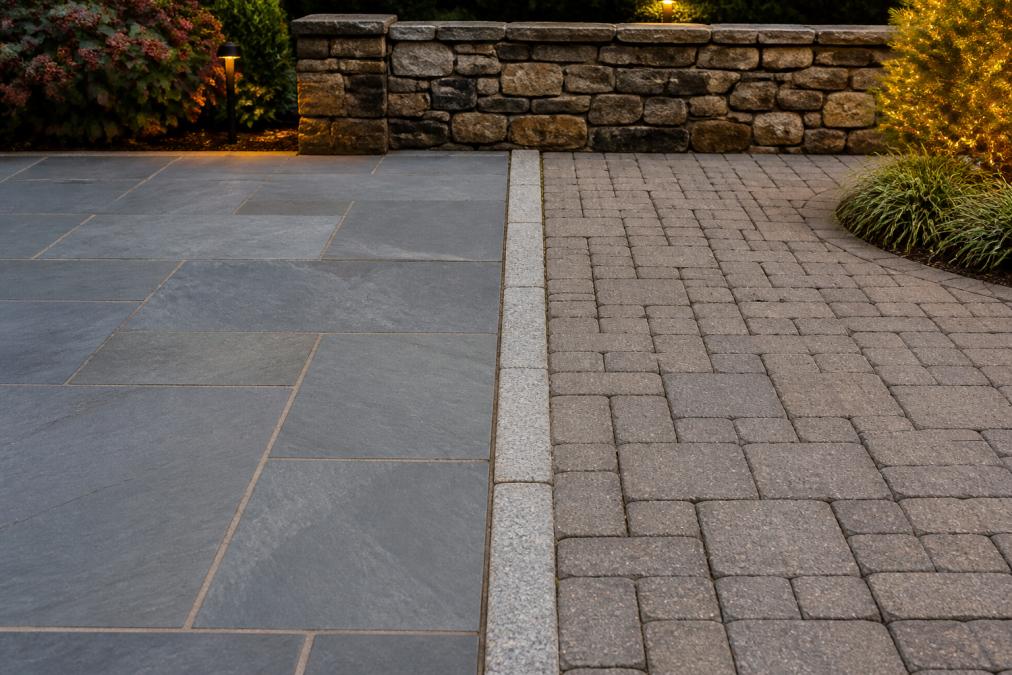
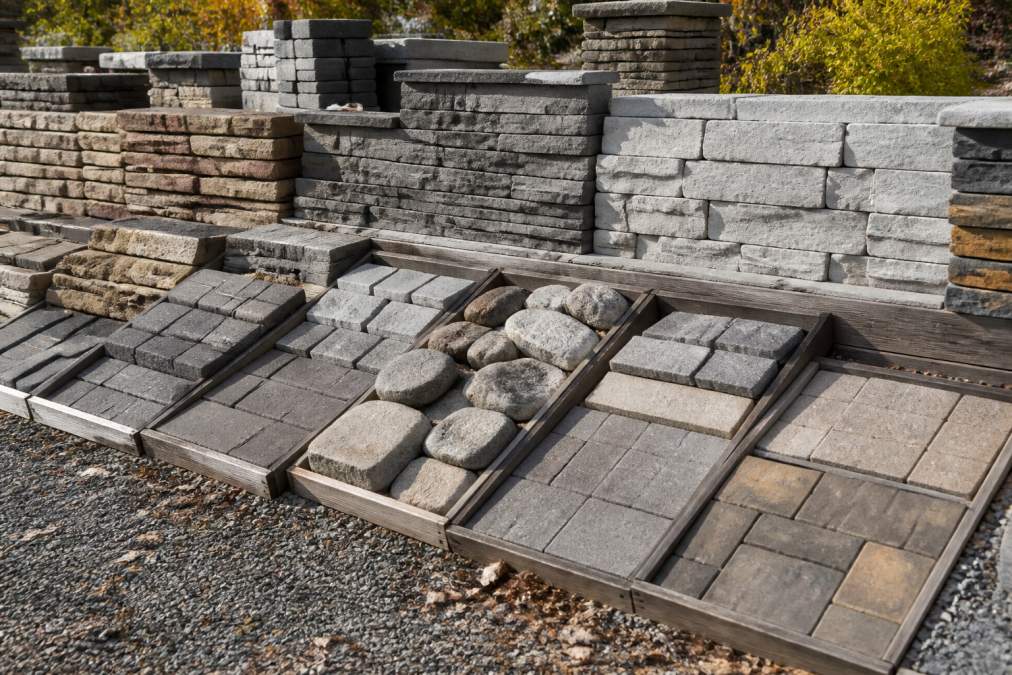
Bluestone, Flagstone, and Granite: The Natural Stone Shortlist
Bluestone, flagstone, and granite are the three natural stones that hold up best in this region.
- Bluestone: Dense, low absorption, and the standard for patios and walkways. Thermally treated bluestone is the most slip-resistant finish.
- Flagstone: Available in sandstone, quartzite, and limestone varieties. Quartzite and harder sandstone perform well; softer limestone needs more care.
- Granite: Extremely hard and nearly waterproof, but heavy and more expensive to install. Best for steps and accent features.
Concrete Pavers: Consistent, Repairable, and Cost-Effective
Concrete pavers offer uniform thickness and color, which makes layout and drainage planning simpler. The real advantage is repairability: if one paver cracks or the base settles, a single unit can be pulled and reset without disturbing the rest.
| Material | Freeze-Thaw Performance | Repairability | Best For |
|---|---|---|---|
| Bluestone | Excellent | Moderate | Patios, walkways |
| Flagstone | Good to excellent | Moderate | Rustic patios, paths |
| Granite | Excellent | Difficult | Steps, accents |
| Concrete pavers | Very good | Excellent | Driveways, walkways |
Permeable Paver Benefits for Drainage and Local Codes
Permeable pavers let stormwater filter through the surface and into the base rather than running off into drains and neighboring properties. For properties with drainage restrictions or tight lot lines, that difference matters. But the bigger driver in this region is not aesthetics or puddles. It is code.
The Regulatory Framework You Are Actually Designing Against
Stormwater management here is governed at the state level by the Department of Environmental Conservation through its stormwater design manual, and enforced locally by each municipality's planning and building departments. The manual sets the technical standard; the town or city sets the review process.
How Permeable Systems Meet the Requirement
A permeable paver installation is not just pavers with wider joints. It is a layered system:
- Open-graded joint aggregate between the pavers, sized to let water pass while still locking the units in place.
- A bedding layer of washed, open-graded stone that does not hold fines.
- A reservoir base of uniformly graded aggregate with void space to store water during a storm.
- An optional underdrain or connection to a drainage system if the subsoil does not infiltrate fast enough.
What to Check Before You Finalize a Design
Requirements vary by town, and the review threshold, how much new impervious surface triggers a stormwater plan, varies too. Before finalizing a design, confirm:
- Whether your project crosses the local impervious-surface threshold that triggers a stormwater review.
- Whether your town accepts permeable pavers as a stormwater control measure, and under what design standard.
- Whether the subsoil on your site infiltrates well enough to use a full-infiltration system, or whether an underdrain is required.
- Whether any local incentive or credit applies for on-site stormwater management.
The Trade-Off
Permeable systems cost more upfront because they require a deeper, carefully graded aggregate base and more precise installation. The payoff is fewer puddles, less ice in winter, a lighter load on municipal drainage, and, in many cases, a design that satisfies a stormwater requirement that a solid surface would not. On a tight lot or a redevelopment project, that can be the difference between a design that gets approved and one that does not.
Retaining Wall Materials and Structural Integrity
Retaining walls fail for one reason above all others: inadequate drainage behind the wall. Hydrostatic pressure from trapped water pushes a wall forward far more often than the weight of the soil it holds back.
Every retaining wall should include:
- A compacted, level base trench below the frost line
- Free-draining gravel backfill
- A perforated drain pipe at the base
- Filter fabric to keep soil out of the drainage stone
Decorative Stone, Ground Cover, and Landscape Design Details
Decorative stone and ground cover are where a hardscape stops being functional and starts looking designed. These materials tie the patio, walkway, and planting beds together.
Hardscape Maintenance Tips by Material Type
Hardscape maintenance tips vary by material, and using the wrong cleaner can do permanent damage. Bluestone and granite tolerate gentle pH-neutral cleaners. Limestone and travertine are acid-sensitive and should never see vinegar or acidic products.
- Natural stone: Sweep regularly, rinse with pH-neutral cleaner, reseal every few years depending on porosity.
- Concrete pavers: Reapply polymeric joint sand as it settles, and clean with a stiff brush and mild detergent.
- Permeable systems: Vacuum or power-blow the joints seasonally to keep them draining.
- Retaining walls: Clear weep holes and check for leaning after each winter.
Choosing the Best Hardscape Materials for Your Property
Choosing the best hardscape materials for NY properties comes down to matching material to use, budget, and site conditions rather than chasing a single "best" option.
Use this decision framework:
- High-traffic driveway: Concrete pavers or granite setts over a deep compacted base
- Primary patio: Thermally treated bluestone or quartzite flagstone
- Garden path: Flagstone, cobbles, or crushed aggregate
- Sloped or drainage-sensitive lot: Permeable pavers
- Retaining structure over 3 feet: Engineered segmental block with full drainage
Conclusion
The hardscape materials that thrive here are the ones chosen for water resistance and installed over a properly compacted, well-drained base. Get that combination right and your patio, walkway, and walls will hold up through every winter.
Frequently Asked Questions
What are the most durable hardscape materials for freeze-thaw cycles?
Bluestone, granite, and high-density concrete pavers handle freeze-thaw best. These materials have low absorption rates and resist cracking when water expands in joints. Proper base layer compaction and joint sand also matter as much as the surface material. In Westchester County, where temperatures swing above and below freezing repeatedly, installations that skip a deep compacted sub-base fail within a few seasons regardless of stone type.
How do I choose between natural stone and concrete pavers for my patio?
Natural stone, like bluestone or flagstone, offers unique color variation and a premium look that suits luxury properties. Concrete pavers provide uniform color, easier repairs, and often cost less upfront. For a patio that sees heavy foot traffic and needs simple maintenance, pavers work well. For a one-of-a-kind outdoor living space where aesthetic appeal drives the decision, natural stone is the stronger choice.
Which hardscape materials require the least amount of maintenance?
Granite, dense bluestone, and quality concrete pavers with polymeric joint sand need the least upkeep. Sealing every two to three years protects against staining and efflorescence. Permeable pavers reduce standing water, which cuts freeze damage. Avoid soft limestone or sandstone in high-traffic areas, as these need more frequent sealing and can chip under snow removal equipment.
Are there eco-friendly hardscape options for residential properties?
Permeable pavers and locally sourced fieldstone are the most eco-friendly choices. Permeable systems let stormwater filter into the ground, reducing runoff and helping with local drainage requirements. Locally quarried stone cuts transportation emissions. Combining permeable walkways with rain gardens and native plantings creates a landscape that manages water naturally while still looking polished.
How does local climate impact the longevity of hardscape installations?
Freeze-thaw cycles are the main threat. Water seeps into joints and pores, freezes, expands, and gradually loosens stones or cracks surfaces. A properly compacted base layer, adequate drainage slope, and joint sand designed for cold climates extend the life of any hardscape. In Westchester, installations built without these details often need repairs within five years, while well-built ones last decades.
What is the difference between permeable and non-permeable hardscape materials?
Permeable materials have gaps or pores that let water pass through into the ground below. Non-permeable surfaces, like standard concrete or tightly jointed stone, push water to the edges. Permeable pavers help with drainage, reduce puddles, and can satisfy local stormwater rules. Non-permeable options often cost less and work fine where drainage is already handled by grading or a French drain.