 listicle
Benefits of Professional Commercial Lawn Care
Table of Contents
- Why Commercial Lawn Care Matters for Your Business
- Enhancing Curb Appeal and First Impressions
- What Commercial Lawn Care Services Include
- Protecting Your Property Value and Asset
- Year-Round Commercial Lawn Maintenance Benefits
- Building a Commercial Lawn Care Program That Works
- Choosing the Right Commercial Lawn Care Provider
- Frequently Asked Questions
Last Updated: October 18, 2026
Why Commercial Lawn Care Matters for Your Business
A well-maintained commercial property sends a clear message to customers, tenants, and employees: you care about details. The benefits of professional commercial lawn care extend far beyond aesthetics. When you outsource lawn maintenance to a dedicated team, you free up internal resources, reduce liability risks, and create an outdoor environment that reflects your business standards.
At Four Seasons Landscaping NY, we've worked with property managers and business owners across Westchester County who initially managed landscaping in-house or pieced together multiple contractors. The shift to consolidated commercial lawn care consistently delivers measurable improvements in property appearance, tenant retention, and operational efficiency. Your outdoor space is often the first impression customers and prospects have of your business, and it's worth getting right.
Enhancing Curb Appeal and First Impressions
The entrance to your commercial property is your visual handshake with the world. A manicured lawn, clean landscape beds, and well-maintained hardscaping signal professionalism and attention to standards. When potential customers pull up to your location or tenants arrive for work, they form opinions in seconds based on what they see.
Professional commercial lawn care ensures your property maintains a consistent, polished appearance year-round. Regular mowing, edging, and bed maintenance eliminate the overgrown or neglected look that undermines your brand. Seasonal plantings and strategic landscaping features add visual interest without requiring internal staff to coordinate multiple vendors.
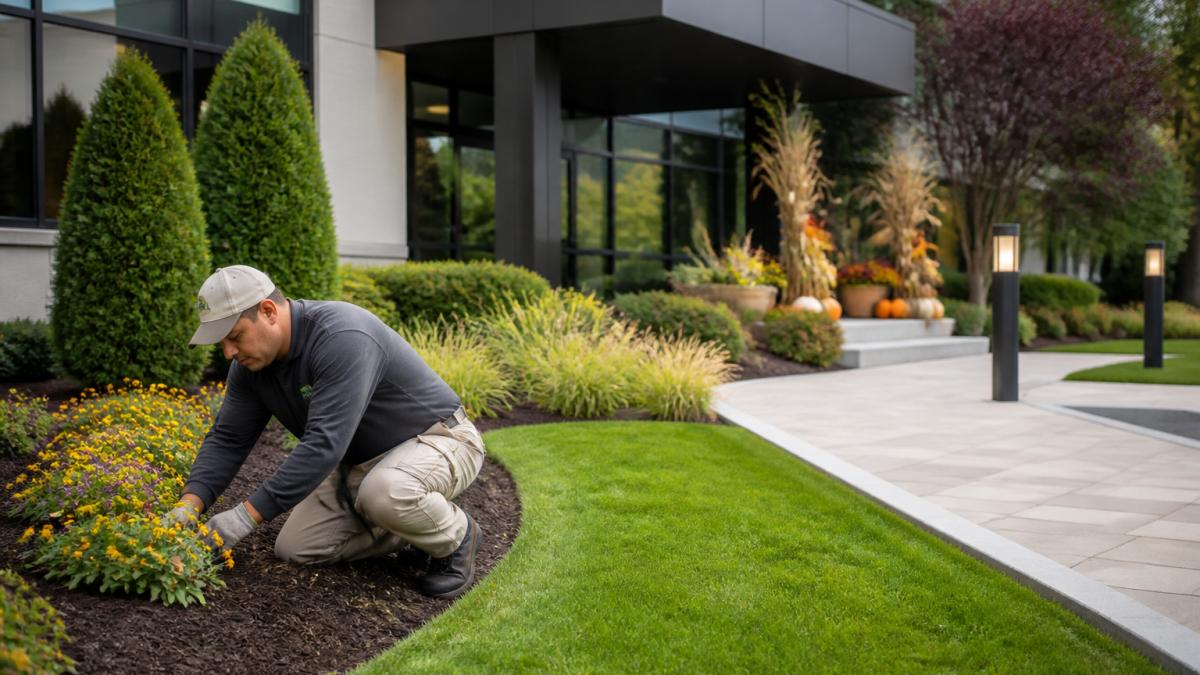
The difference between a property that looks maintained and one that looks neglected often comes down to consistency. Professionals show up on schedule, regardless of weather or competing priorities. This reliability keeps your curb appeal intact through every season, and as the holidays approach, a well-maintained landscape provides the perfect foundation for seasonal enhancements like Holiday Lighting and Décor that elevate your property's visual impact during peak business periods.
What Commercial Lawn Care Services Include
A commercial lawn care program is not a single service, it is a bundle of recurring tasks scheduled around your property type, your peak business hours, and your seasonal risk. Understanding the scope helps you compare proposals apples-to-apples instead of guessing what "full-service" means.
Core maintenance services and how they scale by property type
- Mowing, edging, and trimming, The frequency depends on grass type and growth rate. Cool-season grasses in spring and fall may need weekly cuts; warm-season grasses in peak summer can require the same. Office complexes and retail centers typically schedule mowing outside business hours to avoid customer disruption, while industrial properties may accept daytime service.
- Landscape bed maintenance and mulching, Bed weeding, edging, and mulch refresh are usually scheduled two to three times per year, with a spring refresh and a fall touch-up. Multi-tenant properties often need more frequent bed care because tenant signage and entryways are focal points.
- Fertilization and soil health management, Most commercial programs include three to five fertilization rounds per year, timed to grass type and soil test results. Properties with high-traffic turf, such as bank drive-throughs or restaurant patios, may need additional aeration and overseeding.
- Irrigation system maintenance and auditing, Spring start-up, mid-season checks, and fall winterization are standard. An irrigation audit identifies broken heads, misdirected spray, and pressure issues that waste water and damage turf. This is a common add-on that many basic mowing contracts exclude.
- Seasonal cleanup and debris removal, Spring cleanup removes winter debris and prepares beds; fall cleanup handles leaf removal and cutback of perennials. Properties with mature trees may need multiple fall visits.
- Pest and weed control, Pre-emergent and post-emergent applications are typically scheduled in spring and fall. Commercial properties with high visibility, entrances, parking islands, and signage areas, often require more frequent spot treatment.
- Seasonal plantings and color rotations, Many commercial programs include spring and fall annual color rotations for entrance beds and containers. This is often priced separately from base maintenance.
Services that are commonly add-ons, not included
Irrigation repairs beyond routine maintenance, hardscape power washing, snow and ice management, storm cleanup, and landscape design or installation are usually quoted separately. Ask each provider to mark clearly on the proposal which line items are included in the base price and which are billed per occurrence or per project.
How service schedules differ by property type
- Office complexes, Weekly mowing during growing season, biweekly bed care, and coordinated irrigation checks. Service windows often need to avoid morning arrival and evening departure peaks.
- Retail centers, Higher frequency on entrance and parking island beds, more frequent trash and debris removal, and color rotations timed to shopping seasons.
- Multi-tenant properties, Consistent appearance across shared areas is critical for tenant satisfaction; service-level agreements often specify response times for complaints or visible issues.
- Industrial and warehouse properties, Lower frequency on ornamental beds but strong emphasis on perimeter mowing, weed control along fences, and drainage swale maintenance.
A clear scope document prevents the most common commercial landscaping complaint: paying for a program and discovering that bed weeding, irrigation checks, or fall cleanup were never included.
Protecting Your Property Value and Asset
Your commercial property represents a significant asset. Deferred landscape maintenance doesn't just look bad, it can lead to real damage. Unmaintained lawns develop compacted soil, poor drainage, and pest problems. Overgrown landscape beds can hide irrigation issues or foundation problems. Neglected hardscaping becomes a liability and safety concern.
Professional commercial lawn care protects your investment by catching problems early. Regular maintenance identifies irrigation leaks, soil drainage issues, and pest activity before they escalate into expensive repairs. A well-maintained landscape also prevents the kind of deterioration that accelerates aging of your property.
For properties you plan to sell or refinance, landscape condition directly influences property valuation. Lenders and appraisers notice whether grounds are professionally maintained. A property with a strong outdoor appearance and documented maintenance history commands better terms than one showing signs of neglect.
Year-Round Commercial Lawn Maintenance Benefits
Seasonal transitions present challenges for businesses trying to manage landscaping internally. Spring cleanup, summer growth management, fall preparation, and winter protection each require different approaches and timing. Missing the window for seasonal care creates cascading problems through the rest of the year.
A structured commercial lawn maintenance program coordinates these transitions automatically. Spring includes cleanup, soil preparation, and new plantings. Summer focuses on consistent mowing, watering, and pest management. Fall involves leaf removal, bed preparation, and winterization. Winter maintenance includes snow management and dormancy protection.
This year-round approach prevents the common pattern of neglect during busy seasons followed by expensive catch-up work. Your property maintains consistent appearance and health throughout the year, regardless of how busy your business gets.
Building a Commercial Lawn Care Program That Works
Establishing a successful commercial lawn care program starts with defining your goals. Are you prioritizing curb appeal for customer-facing properties? Managing grounds for tenant satisfaction? Protecting property value? Different priorities shape which services matter most.
Next, document your current landscape conditions and any recurring problems. Do you have drainage issues in certain areas? Persistent pest problems? Aging plant material? This baseline helps a professional provider develop a targeted maintenance plan rather than a generic approach.
Set clear expectations about communication, scheduling, and response times. How will you be notified about seasonal changes or weather-related adjustments? What's the process if you need emergency service? A well-defined program includes these operational details upfront.
Budget for professional service realistically. While commercial lawn care requires investment, it typically costs less than managing multiple contractors separately or dealing with the consequences of deferred maintenance. Request a detailed proposal that breaks down services, frequency, and costs so you understand what you're paying for.
Choosing the Right Commercial Lawn Care Provider
Selecting a commercial lawn care provider is a risk-management decision as much as an aesthetic one. A vendor who lacks insurance, misses scheduled visits, or mishandles pesticides creates liability for your property. Use this checklist to evaluate candidates systematically.
Insurance and licensing
Ask for a certificate of insurance showing general liability coverage and, where required by your state, workers' compensation. Confirm that the policy names your property management company or ownership entity as an additional insured.
References and commercial experience
Request at least three references from commercial properties similar to yours, same property type, similar acreage, comparable traffic. Ask those references specific questions: How often did the crew miss a scheduled visit? How quickly did the provider respond to a problem?
Service-level agreement terms
A written service-level agreement (SLA) should specify:
- Service frequency by task (e.g., mowing every 7 days during growing season)
- Response time for complaints or emergency calls (e.g., within 24 hours)
- Notification process for schedule changes due to weather
- Procedure for additional work authorization and billing
- Termination terms and notice period
A provider who resists putting these terms in writing is telling you something about how they handle disputes.
Equipment and crew standards
Ask what equipment they use on commercial properties, wide-deck mowers for large turf areas, stand-on mowers for tight spaces, and dedicated edging equipment.
Communication and reporting
A strong commercial provider offers a single point of contact, an account manager or crew leader, and a clear channel for reporting issues. Ask whether they provide visit reports, photo documentation, or a client portal.
Pricing transparency
Request a proposal that breaks down pricing by service and frequency, not a single lump sum. Clarify what triggers additional charges: extra visits, storm cleanup, irrigation repairs, or plant replacements.
Questions to ask every candidate
- How many commercial properties do you currently maintain, and what types?
- What is your response time for emergency calls during business hours?
- Who is our day-to-day contact, and how do we reach them?
- What is your process for handling a missed visit or a service complaint?
- Can you provide a sample service calendar and a sample invoice?
At Four Seasons Landscaping NY, we provide commercial property managers with written service-level agreements, documented insurance, and a single account contact so expectations are clear from day one. Our programs are built around your property type and schedule, not a generic template.
Frequently Asked Questions
What are the main benefits of professional commercial lawn care?
Professional commercial lawn care delivers consistent curb appeal that attracts customers and strengthens business reputation. It protects your property asset by preventing damage from neglect, maintains healthy turf year-round, and saves your team significant time and effort. Consolidated services through one provider eliminate scheduling conflicts and ensure cohesive landscape management, while professional expertise identifies and prevents problems before they become expensive repairs.
How does a commercial lawn care program differ from basic maintenance?
A structured commercial lawn care program includes seasonal adjustments, preventive care protocols, and coordinated services like fertilization, aeration, pest management, and design consistency. Basic maintenance typically covers only mowing and occasional trimming. A comprehensive program addresses soil health, long-term landscape goals, and adapts to changing weather and property needs throughout the year, ensuring sustained property value and appearance.
Why should I hire commercial lawn maintenance services instead of managing it in-house?
Professional commercial lawn maintenance services free your staff to focus on core business operations rather than landscape upkeep. Professionals bring specialized equipment, horticultural expertise, and consistent scheduling that in-house teams struggle to maintain. They identify emerging issues early, ensure uniform appearance across your property, and deliver results that reflect your business standards, all while reducing liability and insurance risks associated with property maintenance.
How do I evaluate a commercial lawn care provider?
Look for providers with proven experience managing properties similar to yours, transparent communication about services and timelines, full insurance coverage, and a track record of reliability. Ask for references from established clients, clarify what's included in their maintenance plans, and confirm they understand your specific property needs and aesthetic standards. Verify they offer year-round service and can handle both routine maintenance and seasonal adjustments.