 how-to
Landscape Drainage Solutions for Homes: 7 Steps to Fix Water
Table of Contents
- Landscape Drainage Solutions for Homes: What You'll Need Before You Dig
- What You'll Need Before You Dig
- Step 1: Diagnose Your Drainage Problem
- Step 2: Grading and Slope Correction for Lawns
- Step 3: How to Install a Dry Creek Bed
- Step 4: French Drains, Catch Basins, and Downspout Extensions
- Step 5: Best Materials for Landscape Drainage
- Step 6: Permits, Legal Considerations, and Smart Irrigation Integration
- Step 7: Long-Term Maintenance and Cost Planning
- Frequently Asked Questions
Last Updated: September 21, 2026
Landscape Drainage Solutions for Homes: What You'll Need Before You Dig
Water finds every low spot, failed slope, and blocked pipe. This guide from Four Seasons Landscaping NY covers practical landscape drainage solutions for homes, from diagnosis to installation to upkeep. After 20-plus years in Westchester County, the drainage problems we see are predictable, and fixable.
What You'll Need Before You Dig
Landscape drainage collects, redirects, and discharges surface water and groundwater away from your foundation and yard using grading, pipes, gravel, and planted features.
Before you break ground, gather these basics:
Tools
- Shovel, trenching spade, and a wheelbarrow
- 4-foot level and a line level for checking slope
- String line and wooden stakes
- Hand tamper or plate compactor
- Work gloves, safety glasses, and sturdy boots
Materials
- Perforated pipe and solid PVC pipe
- Drainage aggregate (washed gravel, not fill dirt)
- Geotextile fabric
- Catch basin or drain box
- Splash blocks and downspout extensions
- River rock for dry creek beds
Step 1: Diagnose Your Drainage Problem
Walk your property during or right after a heavy rain. Twenty minutes of watching water move beats a week of guessing.
Look for these signs:
- Standing water that lingers more than 24 hours
- Marshy lawn spots that never dry out
- Water stains or damp walls in the basement
- Soil erosion on slopes and along the foundation
- Gutters that overflow during storms
Step 2: Grading and Slope Correction for Lawns
Grading and slope correction for lawns is the cheapest fix and solves most minor drainage issues on its own.
How to correct a slope:
- Add topsoil to low areas and tamp it firm.
- Remove soil from high spots that block flow.
- Recheck the slope with a level and string line.
- Seed or sod the corrected area right away.
Step 3: How to Install a Dry Creek Bed
Learning how to install a dry creek bed gives you a feature that looks intentional and moves water at the same time, the best option for a swale carrying runoff across a lawn.
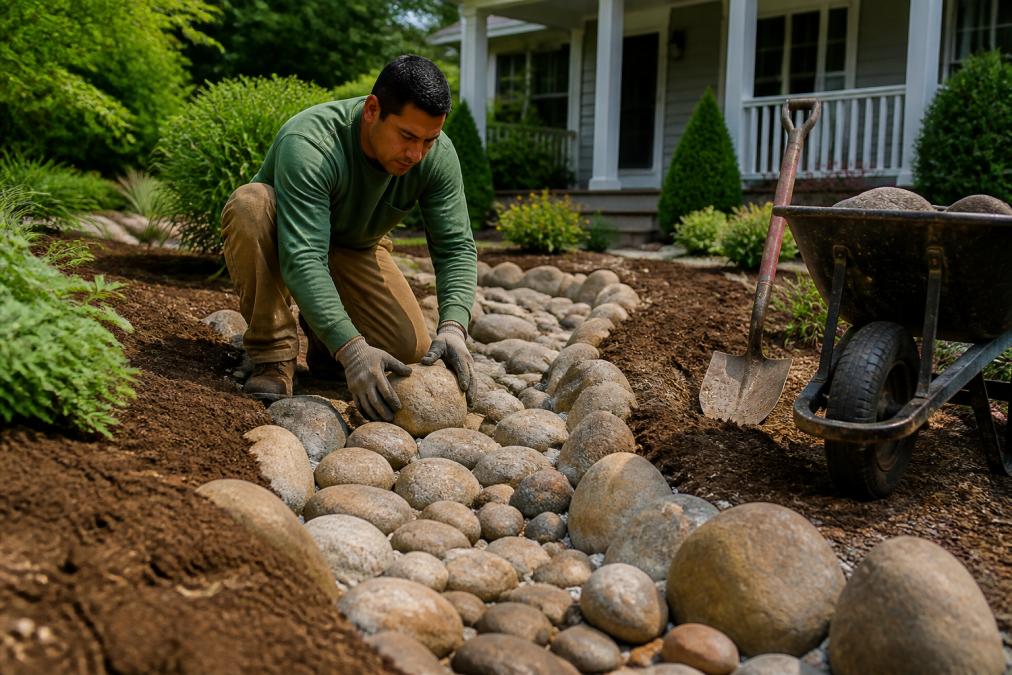
Follow these steps:
- Lay out the path. Follow the natural low line where water already flows.
- Dig the trench. Make it 12 to 18 inches deep and wider than the finished bed.
- Line it with geotextile fabric. This keeps soil from clogging the rock.
- Add drainage aggregate. A 4 to 6 inch base layer supports the stone.
- Set river rock on top. Vary stone sizes for a natural look.
- Check the slope. Water should move downhill the whole way.
Step 4: French Drains, Catch Basins, and Downspout Extensions
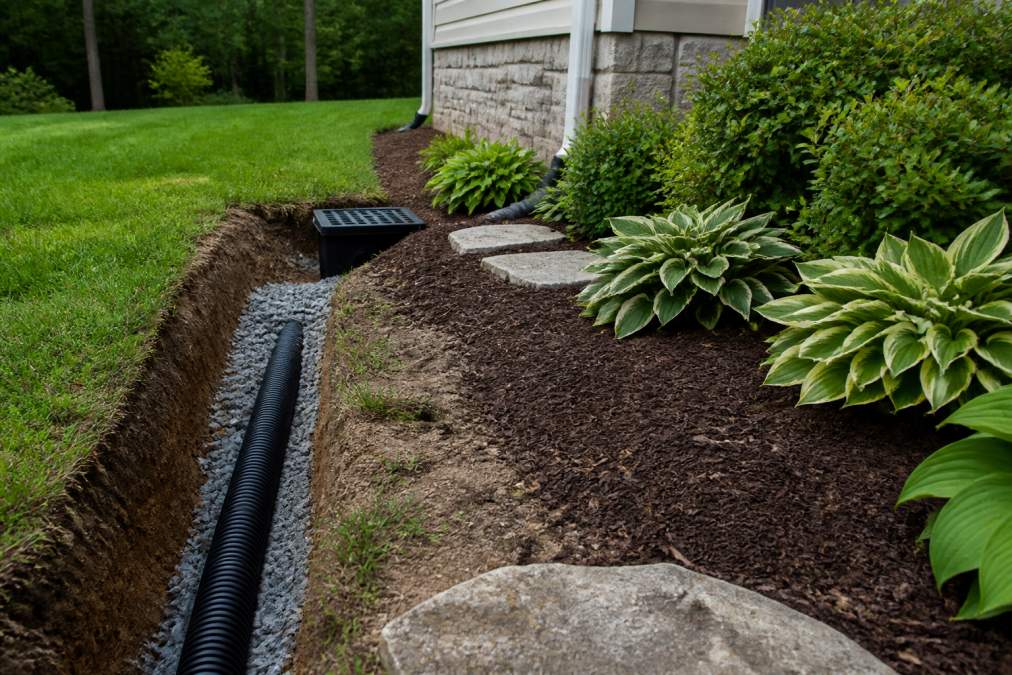
A French drain is a gravel-filled trench holding a perforated pipe that collects groundwater and carries it away, the workhorse of landscape drainage, handling water grading alone can't move.
Pair it with these components:
- Catch basins and drain boxes collect surface water at low points and connect to your pipe run.
- Downspout extensions and splash blocks carry roof water at least 4 to 6 feet from the foundation.
- Curtain drains intercept water before it reaches a wet area.
Step 5: Best Materials for Landscape Drainage
The best materials for landscape drainage are matched to your soil and water volume. There's no single winner.
| Material | Best For | Watch Out For |
|---|---|---|
| Perforated pipe | Groundwater collection | Clogs without a fabric sock |
| Solid PVC pipe | Moving water downhill | Rigid, needs careful trenching |
| Drainage aggregate | Backfill and bedding | Never substitute fill dirt |
| Geotextile fabric | Keeping soil out of gravel | Must overlap at seams |
| Catch basin | Surface water at low spots | Size it to your flow |
Step 6: Permits, Legal Considerations, and Smart Irrigation Integration
Most drainage guides skip this section, and it's the one that can cost you most if you get it wrong. Before renting a trencher, answer three questions: Does your project need a permit? Where does the water legally end up? And are you adding water to soil you're also trying to drain?
When a Permit Is Likely Required
Not every drainage project needs a permit, but the ones that do are usually the ones homeowners start without checking. Common triggers:
- Changing where stormwater leaves your property. Regrading that redirects flow to a new discharge point often crosses the line from landscaping into stormwater management.
- Work inside a regulated buffer. If your yard backs up to a stream, wetland, or floodplain, a buffer or floodplain ordinance may apply even for a small dry creek bed.
- Connecting to the municipal storm system. Tying a catch basin or French drain discharge into a curb inlet or storm sewer usually requires approval, and some jurisdictions prohibit it outright.
- Disturbing soil above a threshold. Many municipalities set a square-footage trigger for grading permits. A single dry creek bed may fall under it; a full-yard regrade usually won't.
The Neighbor Problem
Water is the one thing your property line doesn't stop. Two legal concepts matter:
- The common enemy rule. In many states, surface water is treated as a "common enemy," meaning a homeowner can divert it off their land even if it flows onto a neighbor, as long as they don't do it maliciously or unreasonably.
- The reasonable use rule. Other states require that any diversion be reasonable, weighing the benefit to you against the harm to your neighbor. Concentrating a sheet flow into a single pipe pointed at your neighbor's foundation is the classic example of unreasonable use.
HOA and Deed Restrictions
In an HOA community, the architectural review committee usually has its own approval process separate from the city. Common sticking points:
- Visible drainage features (dry creek beds, pop-up emitters, exposed pipe) may need design approval.
- Discharge onto common areas or neighboring lots is typically prohibited.
- Some associations require a licensed contractor for any work affecting shared drainage.
Smart Irrigation Integration
This separates a drainage plan from a water management plan. A smart controller uses local weather data and soil moisture sensors to skip irrigation cycles when the ground is already saturated, exactly when you don't want to add water to a yard you're trying to dry out.
A few practical integrations:
- Rain sensors shut off irrigation after measurable rainfall. They're inexpensive and often required by local water ordinances in drought-prone areas.
- Soil moisture sensors placed in the same zones as your drainage features tell the controller when the soil has actually drained, not just when it stopped raining.
- Zone separation keeps irrigation heads away from catch basins and dry creek beds, so you're not watering your drainage system.
Step 7: Long-Term Maintenance and Cost Planning
Most drainage articles end at installation. That's a mistake, the system that fails in year six is almost always the one that was never maintained. Here's what upkeep looks like and how systems compare over 5 to 10 years.
The Maintenance Calendar
Drainage systems fail slowly, and warning signs are easy to miss. A realistic schedule:
- Spring and fall: Clear catch basins, grates, and emitter outlets of leaves and debris. This is the single highest-value task, a clogged basin turns a working system into a pond.
- Annually: Flush pipe runs with a hose or pressure jetter. Perforated pipe is the most clog-prone component; if flow slows noticeably, it's already partially blocked.
- After frost heave season: Recheck slope on graded areas and dry creek beds. Freeze-thaw cycles shift soil and stone, and a bed that drained in October may pool in March.
- After heavy storms: Inspect downspout extensions, splash blocks, and pop-up emitters. These are the cheapest parts to replace and the most likely to be knocked loose.
- Every few years: Top-dress gravel in French drain trenches and reset any shifted river rock. Aggregate settles and compacts over time.
What Drives Long-Term Cost
Installation cost is the visible number; cost of ownership is the one that surprises homeowners. Four factors drive it:
- System type. A dry creek bed is nearly maintenance-free once built, occasional rock resetting and debris clearing. A French drain with perforated pipe needs periodic flushing and, eventually, partial replacement of clogged sections. Catch basins need the most frequent attention because they're designed to collect debris.
- Soil and sediment load. Sandy soils pass water quickly but fill gravel with fines. Clay soils drain slowly and stress every component. Either way, sediment is the enemy, and geotextile fabric is what buys you years.
- Tree cover. A yard under maples or oaks loads gutters, basins, and emitters with organic debris every fall. Properties with heavy canopy should expect to clean catch basins more than twice a year.
- Access for equipment. Systems installed in tight side yards or behind fences are harder to service, which raises the cost of any repair or replacement.
A 5-to-10-Year View by System
Rather than quote prices that vary by region and scope, think in terms of relative cost of ownership:
| System | Upfront Effort | Ongoing Maintenance | Typical Replacement Horizon |
|---|---|---|---|
| Grading and slope correction | Low | Low, reseed and recheck after settling | Effectively permanent if stabilized |
| Dry creek bed | Moderate | Low, clear debris, reset stone | 10+ years with fabric intact |
| French drain (perforated pipe) | High | Moderate, annual flush, spot repairs | 10-20 years depending on sediment load |
| Catch basin and solid pipe run | Moderate | High, frequent debris clearing | Pipe lasts decades; basin lids and grates wear |
| Downspout extensions and splash blocks | Low | Low, replace after storms | 3-7 years for flexible extensions |
Hydrostatic Pressure: The Quiet Enemy
Once the ground is draining the way it should, the same crew can handle the seasonal work up top, Holiday Lighting and Décor installation that has your roofline, trees, and entryways lit and looking sharp well before the first guests arrive.
Frequently Asked Questions
What is the best way to improve drainage around my house?
The most effective approach combines several landscape drainage solutions. Start with grading and slope correction to move surface water away from the foundation. Add downspout extensions to carry roof runoff at least 4 to 6 feet from the house. For persistent problems, install a French drain or dry creek bed. In Westchester County, where clay-heavy soil slows absorption, a drainage contractor can assess whether you need a curtain drain or catch basin system. Most properties benefit from a layered approach rather than a single fix.
How do I know if my property has a drainage issue?
Watch for standing water 24 hours after rain, a marshy lawn, water stains in the basement, soil erosion on slopes, and foundation cracks. You may also notice hydrostatic pressure pushing water through basement walls or a sump pump running constantly. These signs mean surface water is not moving away fast enough. Addressing grading and slope correction early prevents expensive foundation repairs later. A professional drainage assessment can pinpoint the source.
Can I use gravel alone to solve drainage problems in my yard?
Gravel by itself rarely solves drainage issues. A gravel-filled hole without a perforated pipe or proper outlet just fills with water and saturates the surrounding soil. Gravel works best as part of a complete system: a trench lined with geotextile fabric, a perforated pipe, drainage aggregate, and a clear outlet point. For surface water, a dry creek bed with gravel and larger rocks can channel runoff effectively when installed with the right slope.
How much does landscape drainage installation cost?
Pricing depends on the size of your property, the type of drainage system, soil conditions, and whether excavation is needed. A simple downspout extension costs far less than a full French drain or curtain drain system. Long-term maintenance costs, including periodic cleaning and regrading, should also factor into your budget. For an accurate quote tailored to your property, contact a landscape drainage professional for an on-site assessment.
Drainage problems don't fix themselves, and they get worse with every storm. Four Seasons Landscaping NY designs and installs complete landscape drainage systems, from grading and dry creek beds to French drains and irrigation. With over 20 years of experience and a fully insured crew, we handle the design, the excavation, and the year-round upkeep so your property stays dry. Get your free quote and put a plan in place before the next heavy rain.