 how-to
How to Choose Energy Efficient Holiday Lights
Table of Contents
- How to Choose Energy Efficient Holiday Lights: What You'll Need Before You Shop
- LED vs. Incandescent Christmas Lights: What the Difference Means for Your Display
- Holiday Light Wattage and Energy Use: How to Estimate Your Seasonal Cost
- Choosing Outdoor-Rated Holiday Lights for Weather and Durability
- Bulb Styles, Colors, and Effects: Mini, C7, C9, and Smart Controls
- Holiday Light Safety Tips for Indoor and Outdoor Displays
- Step-by-Step: How to Choose Energy Efficient Holiday Lights for Your Home
- Conclusion: Making the Switch and Planning Ahead
- Frequently Asked Questions
Last Updated: October 13, 2026
How to Choose Energy Efficient Holiday Lights: What You'll Need Before You Shop
Switching your display to LED strings cuts electricity use by 75% to 90% compared with incandescent bulbs, according to U.S. Department of Energy guidance on LED lighting. At Four Seasons Landscaping NY, we install holiday lighting and décor across Westchester County, and the homeowners who plan ahead get better results for less money.
Energy efficient holiday lights are lighting products that deliver the same brightness as standard bulbs while drawing far less power, usually LED strings rated for low wattage and long life. They run cool, last for years, and cost less to operate.
What most buying guides skip: the bulb you pick matters less than how you plan the display. A well-mapped roofline with the right string count beats a random cart full of lights.
Measure Your Display Areas and Count Outlets
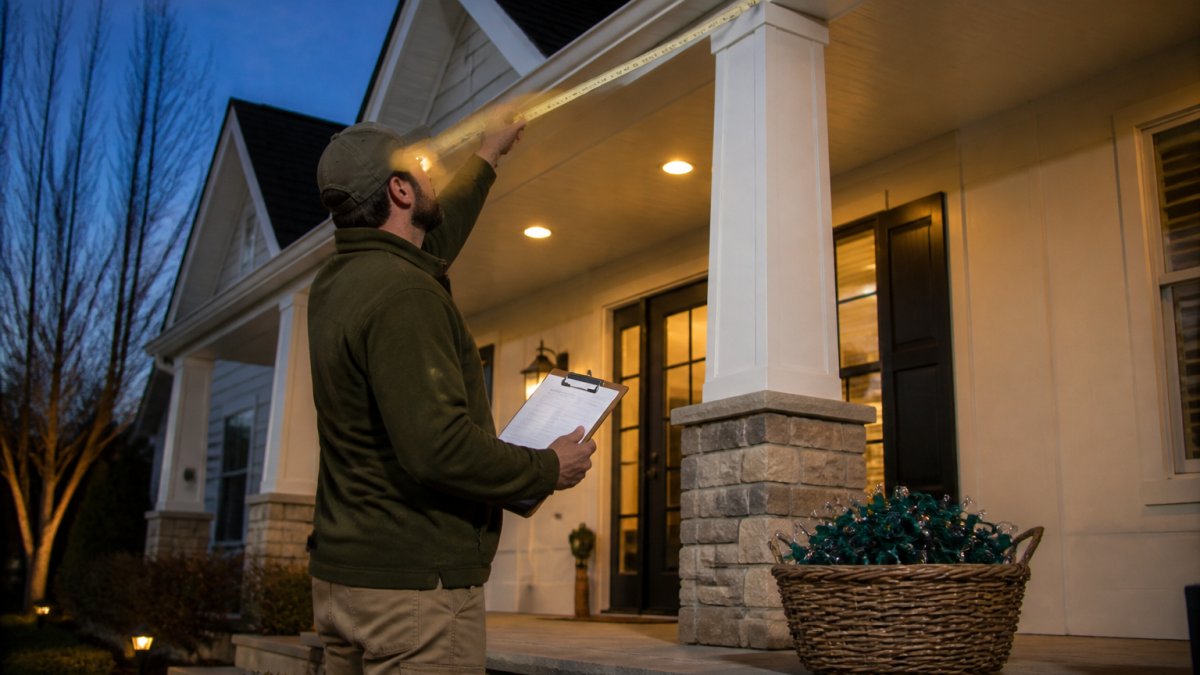
Walk your property with a tape measure and notepad, noting every surface you plan to light.
- Roofline: measure the full run, including gables and dormers
- Trees and shrubs: note height and spread for wrap counts
- Walkways and railings: measure length and post spacing
Next, count your outdoor outlets and note where they sit. You will also want to check whether each outlet is GFCI protected, since the U.S. Consumer Product Safety Commission outdoor decoration safety guidance points to ground-fault protection as a baseline for outdoor electrical use.
Add up your total linear feet, then add 10% for overlap and mistakes.
LED vs. Incandescent Christmas Lights: What the Difference Means for Your Display
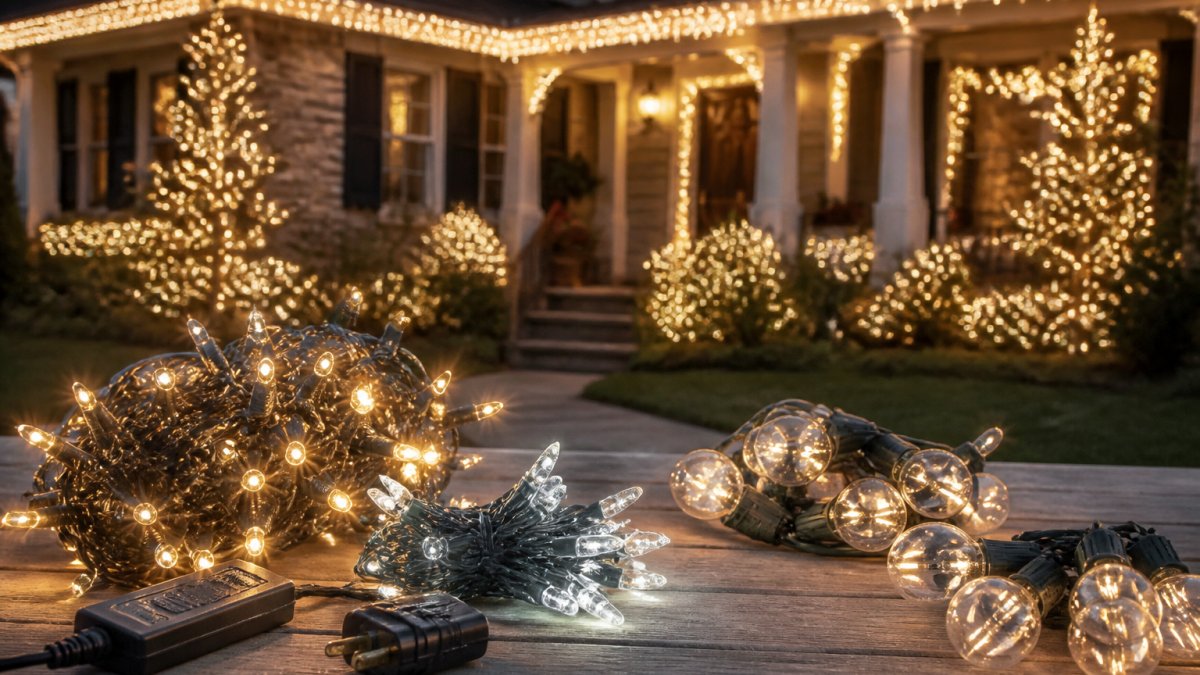
LED vs. incandescent Christmas lights comes down to three things: power draw, heat, and lifespan. LEDs use a fraction of the electricity, stay cool to the touch, and last many seasons.
For a large roofline or several trees, LEDs are the only practical choice for keeping electricity use reasonable. For one small tree and an old-fashioned glow, incandescent can still work.
Why Some Homeowners Still Prefer Incandescent
Nostalgia is real, and so is the light quality. Incandescent bulbs give off a soft, amber warmth some homeowners associate with childhood displays, and they dim smoothly with basic plug-in dimmers.
The catch is upkeep: incandescent strings fail bulb by bulb, and one dead bulb can take a whole section down. Expect more replacements and troubleshooting.
Holiday Light Wattage and Energy Use: How to Estimate Your Seasonal Cost
Holiday light wattage and energy use is simple math once you know two numbers: watts per string and your electricity rate. Multiply watts by hours used, divide by 1,000 for kilowatt-hours, then multiply by your rate. The same display can swing from a rounding error to a noticeable line item depending on which strings you hang.
Here is the formula in plain terms:
- Find the wattage on the string's label
- Multiply by the number of strings in your display
- Multiply by hours lit per night
- Multiply by nights in the season
- Divide by 1,000 to convert to kilowatt-hours (kWh)
- Multiply by your electricity rate per kWh
A Worked Example You Can Copy
Say your roofline and two front shrubs take 10 strings, run 5 hours a night for 45 nights, at 16 cents per kWh, a common residential figure, though yours is on your utility bill.
LED strings at 4.8 watts each:
- 10 strings x 4.8 watts = 48 watts total
- 48 watts x 5 hours = 240 watt-hours per night
- 240 x 45 nights = 10,800 watt-hours
Incandescent strings at roughly 40 watts each for comparable brightness:
- 10 strings x 40 watts = 400 watts total
- 400 watts x 5 hours = 2,000 watt-hours per night
- 2,000 x 45 nights = 90,000 watt-hours
Same display, same hours, same look from the street, roughly an eight-fold difference in operating cost. Scale that to 30 or 40 strings and the gap widens fast, which is why LED strings pay for themselves within a season or two on a big display.
Reading Energy Labels and Product Specs
Every light string sold in the U.S. carries a label listing watts, amps, and connectability. Read it before you buy. Look for four things:
- Wattage per string: lower is better for the same brightness. Mini LEDs often land between 3 and 5 watts per 50-light string; incandescent equivalents can run 20 to 40 watts.
- Amps: this tells you how much current the string pulls. Amps x 120 volts = watts, so you can cross-check the label if wattage is not printed.
- Connectable rating: how many strings can safely link end to end. This is a hard limit, not a suggestion.
To compare two boxes on the shelf, divide the string's wattage by its light count to get watts per bulb. That number lets you compare a 100-light mini string against a 25-light C9 string on equal footing.
The Federal Trade Commission guidance on energy labeling explains how energy information on consumer products is presented, which helps you compare strings on equal footing.
Total Cost of Ownership Over Several Seasons
Purchase price is only one slice of what a string costs. The fuller picture is purchase price plus electricity plus replacements, spread across the seasons the string survives.
A common pattern: incandescent strings cost less up front but burn out faster, so you replace them every season or two. LED strings cost more up front but last many seasons at a fraction of the electricity draw.
Choosing Outdoor-Rated Holiday Lights for Weather and Durability
Outdoor-rated holiday lights handle rain, snow, and temperature swings, and they are the only safe choice for exterior displays.
Durability varies by build quality. Commercial-grade strings use thicker wire and sealed sockets, surviving winter after winter while bargain strings fail by January. For rooflines or tree wraps, commercial-grade pays for itself.
Weather exposure also affects lifespan. Strings left up year-round degrade faster than strings stored properly.
Bulb Styles, Colors, and Effects: Mini, C7, C9, and Smart Controls
Bulb type and size shape the look of your display more than anything else. Mini lights suit dense wrapping and fine detail, C7 bulbs give a classic mid-size glow for rooflines, and C9 bulbs read best from the street.
Color temperature matters too. Warm white feels traditional and pairs with wreaths and garland; cool white reads crisp and modern; multicolor suits family displays.
| Bulb Style | Best Use | Look | Notes |
|---|---|---|---|
| Mini | Tree wraps, shrubs, garland | Dense, detailed | Lowest wattage per string |
| C7 | Rooflines, windows | Classic mid-size glow | Good balance of look and draw |
| C9 | Rooflines, large trees | Big, visible from street | Fewer strings needed per run |
| Smart LED | Any display | Adjustable color and brightness | Timers and scheduling built in |
Smart Controls and Scheduling: The Quiet Upgrade
Smart controls are the upgrade most homeowners miss, and the easiest way to cut energy use without changing how the display looks. Lights only need to run during the hours people actually see them, and a timer or smart plug enforces that automatically, so you stop paying for the hours between midnight and dawn.
Here is the runtime math. A 45-night season at 7 hours a night is 315 hours; trim to 5 hours and you are at 225, a 29% cut in energy use with zero change to the display.
Three control options, from simplest to most flexible:
- Mechanical plug-in timer: dial or pins set on/off times. Cheap, no app, no Wi-Fi. Best for a single outlet with one or two strings.
- Smart plug: pairs with your phone over Wi-Fi. You set schedules, and many models support sunrise/sunset triggers so the display turns on at dusk automatically.
- Smart controller with dimming and color: handles multiple zones, lets you dim brightness, and can run color-changing effects. Best for larger displays or anyone who wants scene changes.
Using Smart Controls Safely Outdoors
Outdoor use adds a few rules indoor setups do not have:
- Plug the controller into a GFCI-protected outlet, and keep the controller itself off the ground and under a cover.
- Check the controller's outdoor rating. A smart plug rated for indoor use only will fail in rain or snow, even if it works fine the first week.
- Confirm the controller's wattage limit covers your full string load. A controller rated for 15 amps at 120 volts handles roughly 1,800 watts, which is far more than most residential displays draw, but check the label rather than assuming.
A practical schedule for most homes: on at dusk, off at 11 p.m. on weeknights, and off at midnight on weekends. That captures every hour the display is actually seen and skips the overnight hours entirely.
Holiday Light Safety Tips for Indoor and Outdoor Displays
Safety comes down to ratings, connections, and heat. Use only strings rated for where you install them, keep connections off the ground, and never overload an outlet or extension cord.
A short checklist for both indoor and outdoor setups:
- Check every string for cracked sockets or frayed wire before hanging
- Use GFCI-protected outlets for all outdoor runs
- Keep plugs elevated and covered, never in standing water
LED strings run cool to the touch, which lowers heat risk compared with incandescent bulbs. That does not remove the electrical risk. Water and damaged cords are the real hazards.
Step-by-Step: How to Choose Energy Efficient Holiday Lights for Your Home
Here is the process we walk clients through, in order.
- Measure every surface you plan to light and total the linear feet
- Count outdoor outlets and confirm GFCI protection
- Decide on bulb style by surface: mini for detail, C7 and C9 for rooflines
- Pick LED strings rated for outdoor use where they will be exposed
- Check the label for wattage and connectable limits
- Estimate your seasonal cost using the formula above
- Add smart controls for timers and scheduling
- Buy 10% extra for overlap and replacements
- Install safely with GFCI outlets and elevated connections
- Store properly at season's end to protect your investment
If the measuring and installation sounds like a weekend you would rather not spend on a ladder, that is exactly the work we handle. Our holiday lighting and décor service covers design, installation, and takedown, so your display goes up on schedule and comes down without you climbing anything.
Common Mistakes to Avoid
The same errors show up every season.
- Buying lights before measuring, then running short mid-install
- Mixing LED and incandescent strings on one circuit without checking the load
- Using indoor-rated strings outside to save money
Conclusion: Making the Switch and Planning Ahead
The challenge with holiday lighting is not picking a bulb. It is doing the measuring, the math, and the installation before the season arrives. Four Seasons Landscaping NY has handled holiday lighting and décor for Westchester County properties for over 20 years, with transparent quotes, no hidden fees, and a fully insured crew. Get your free quote and get on the calendar before the rush.
Frequently Asked Questions
How much electricity do LED holiday lights use compared to incandescent?
LED holiday lights use 75% to 90% less energy than incandescent bulbs. A typical 100-bulb string of incandescent mini lights draws about 40 watts, while a comparable LED string draws roughly 4 to 10 watts. Over a 30-day season at 5 hours per night, that difference can cut operating cost significantly. Check the packaging wattage to calculate your specific display's energy use.
What should I look for in outdoor-rated holiday lights?
Look for a UL listing marked for outdoor use, sealed sockets, and weather-resistant wiring. Commercial-grade strings with thicker insulation last longer in rain, snow, and wind. Choose LED bulbs rated for outdoor temperatures, and verify connectable string limits so you do not overload a circuit. Proper outdoor-rated holiday lights reduce safety risks and replacement costs.
Are incandescent Christmas lights safe to use?
Incandescent Christmas lights are safe when used correctly, but they generate more heat than LEDs. Keep them away from dry materials, never overload outlets, and inspect cords for damage before each season. Because they run hotter, they are less ideal for long indoor displays or wrapped around fabric. LED lights stay cool to the touch, which lowers fire risk.
Can I connect multiple LED light strings together?
Yes, most LED light strings are connectable, but the number you can link depends on the manufacturer's rating. Check the packaging for the maximum connected wattage or string count, and never exceed the fuse rating. If you are unsure, divide your display into separate runs plugged into different outlets or a power strip with overload protection. Smart plugs can help manage multiple zones.