 ultimate-guide
How to Choose a Landscape Contractor: A 2026 Guide
Table of Contents
- Define Your Landscaping Needs and Project Scope
- Essential Questions to Ask a Landscape Contractor
- Verify Licenses, Insurance, and Professional Credentials
- Review Portfolios, References, and Past Project Experience
- Landscape Contractor Vetting Checklist
- Landscape Contract Red Flags and What to Avoid
- Hiring Landscape Design-Build Firms for Full-Service Projects
- Frequently Asked Questions
Last Updated: September 20, 2026
Define Your Landscaping Needs and Project Scope
Before contacting contractors, clarify your needs, when you choose landscape contractor services, understand that the right contractor for hardscaping differs from one for softscaping or full design overhauls.
Walk your property and identify needs: complete design, installation for specific areas, maintenance, or structural changes (patios, retaining walls, irrigation). Write down specifics: which areas, what problems, and desired results.
Vague descriptions lead to surprise costs and wildly varying bids. Articulate your scope clearly so contractors can provide accurate estimates.
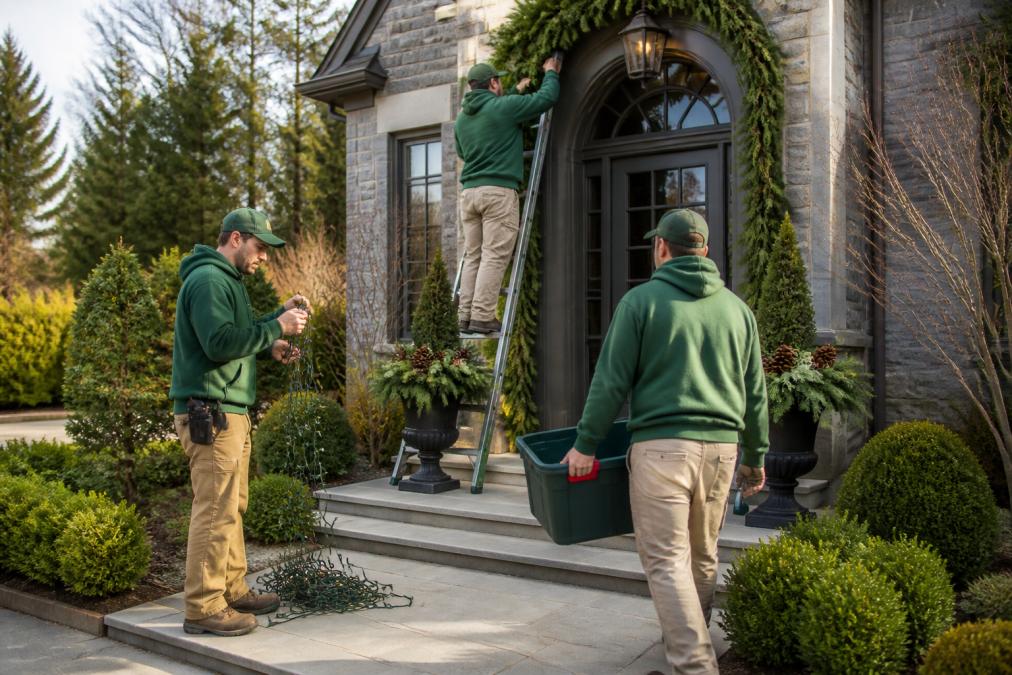
Define your timeline early. For holiday lighting and décor, the best contractors book up fast, start vetting immediately to secure seasonal availability.
Essential Questions to Ask a Landscape Contractor
The right questions reveal experience and separate informed homeowners from those facing surprise costs and missed timelines.
Experience and Project Scope
Ask: "Have you completed projects like mine?" Push for specifics on materials, timeline, and budget. Confident, detailed answers signal experience; vague reassurances signal inexperience.
Pay attention to how they describe past projects. "We specialize in residential hardscaping and have completed 40+ patio projects in three years" signals depth; "We do all kinds of work" signals they take anything.
Team Structure and Accountability
Ask whether the same crew handles your entire project or rotates, and whether they employ their own crew or use subcontractors. Know who's on your property and whether continuity is maintained.
Crew consistency impacts quality. Ask: "Who will be the lead, and will they be here start to finish?" A dedicated project lead signals accountability.
Process and Planning Depth
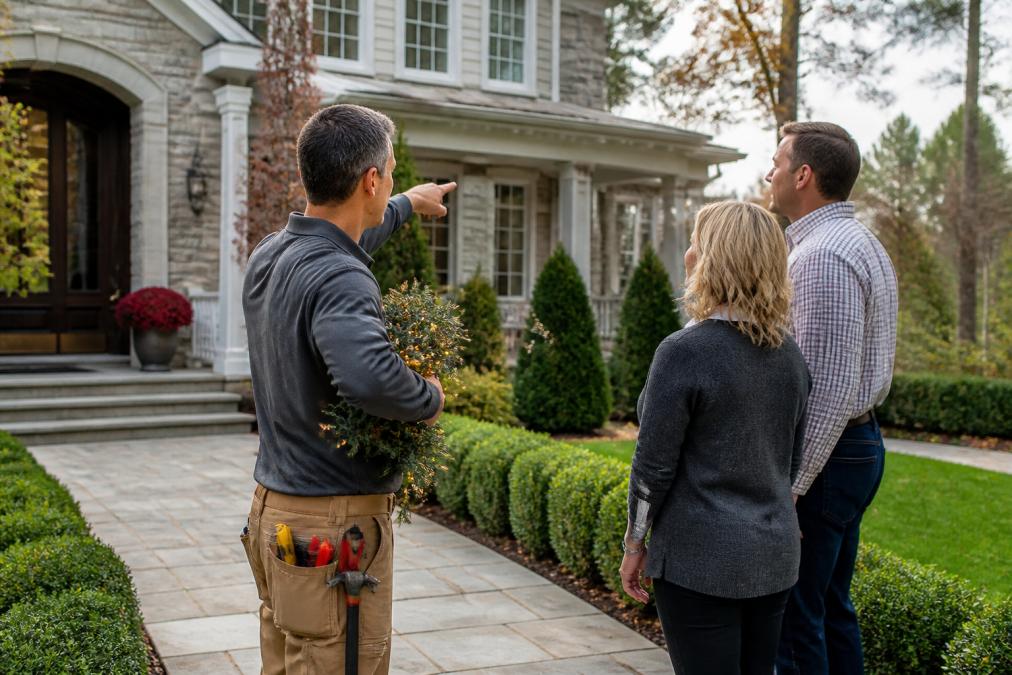
Ask about their site assessment process: How many visits before an estimate? Do they create mockups or renderings? Their process reveals how seriously they take precision.
Ask: "How many site visits before an estimate?" One visit is a red flag; two to three is standard. Thorough contractors measure, photograph, assess drainage and soil, and ask detailed questions about yard use, problems, and maintenance tolerance.
Communication and Change Management
Ask about communication frequency, your main contact, and their change-order process. Weekly updates and clear procedures signal professionalism.
Ask: "How do we handle mid-project changes?" Professional contractors require written change orders documenting scope, cost, and timeline impacts before work begins. "We'll figure it out as we go" is a warning sign.
Post-Installation Support
Ask about post-installation support: workmanship warranty, maintenance services, and for seasonal work like holiday lighting and décor, whether they handle takedown and storage. Get warranty specifics in writing.
A clear, written one-year warranty signals confidence. Vague warranty terms invite disputes.
Verify Licenses, Insurance, and Professional Credentials
Request proof of current business license and verify with your state or local licensing board. Most jurisdictions require licensing above a certain work value.
Ask for a certificate of general liability insurance (minimum $1 million) and workers' compensation insurance. Both protect you from liability.
Ask if they're bonded. A performance bond signals confidence in delivery, though not always required.
Check for professional affiliations (National Association of Landscape Professionals, regional associations). Not required, but positive indicators.
Don't skip verification because you like the contractor. A contractor who resists providing proof is a red flag.
Review Portfolios, References, and Past Project Experience
A strong portfolio shows what a contractor actually delivers. Understand the context, not just the photos.

Request projects similar in scope and style to yours. Assess material quality, installation precision, and whether the aesthetic matches your vision.
Call at least three recent references. Ask: Did they finish on time? Stay within budget? Handle problems well? Communicate effectively? Would you hire again?
Visit completed projects in person if possible. Photos can be misleading; seeing work up close reveals durability and quality.
Look for patterns across references. Consistent praise for communication and quality is good; complaints about accessibility or corner-cutting are red flags.
Landscape Contractor Vetting Checklist
| Evaluation Criterion | Status | Notes |
|---|---|---|
| Business license verified with state/local board | ☐ | |
| Current general liability insurance (min. $1M) | ☐ | Coverage limits: |
| Workers' compensation insurance on file | ☐ | |
| Performance bond available | ☐ | |
| Professional affiliations documented | ☐ | Organizations: |
| Portfolio reviewed with relevant project examples | ☐ | Project types: |
| Minimum three references contacted | ☐ | Overall feedback: |
| Site assessment completed | ☐ | Date: |
| Detailed written estimate provided | ☐ | Amount: |
| Payment schedule clearly outlined | ☐ | Terms: |
| Warranty terms in writing | ☐ | Coverage: |
| Change order process explained | ☐ | |
| Communication plan established | ☐ | Contact frequency: |
| Timeline and project schedule provided | ☐ | Start date: |
Landscape Contract Red Flags and What to Avoid
Certain patterns signal trouble. Understanding why these red flags matter separates homeowners who recover from disasters and those who don't.
The Written Estimate and Scope Definition
A contractor who won't provide a written estimate is a red flag. You need a detailed, itemized breakdown of labor, materials, and timeline.
The estimate must include a detailed scope of work:
- Specific materials (not "mulch" but "3 cubic yards of cedar mulch, 2-3 inch depth")
- Exact areas or dimensions (not "patio" but "16' × 20' patio, 2-inch flagstone with polymeric sand joints")
- Site prep and removal ("Removal of existing lawn, grading, and soil amendment included" or "not included")
- Exclusions ("Does not include irrigation, lighting, or drainage work")
- Timeline ("Installation: June 15-July 2, 2025")
Vague contracts invite conflict. Specify exactly what work, materials, and finished product are included. Avoid language like "general landscaping work" or "as discussed."
Payment Schedules and Financial Protection
Avoid contractors demanding full upfront payment. Standard schedules: deposit (25-33%), progress payments at milestones, final payment upon completion. Full upfront payment leaves you with no leverage.
Your contract should specify:
- Exact deposit amount and what it covers
- When progress payments are due (tied to specific milestones, not arbitrary dates)
- What triggers final payment (completion of all work, your written approval, or both)
- Whether retainage is held (typically 5-10% held back for 30 days after completion to ensure any punch-list items are fixed)
Warranty and Workmanship Terms
Contracts must include a warranty clause. Minimum: one-year workmanship warranty. If they won't stand behind their work, question why.
Your contract should specify:
- Workmanship warranty period (e.g., "One year from completion date")
- What's covered (defects in installation, settling, plant death if plants are included)
- What's not covered (normal wear, damage from weather events, lack of maintenance)
- How warranty claims are handled (who fixes it, at what cost, how quickly)
Material warranties (pavers, stone, irrigation) come from manufacturers and are separate from workmanship warranties. Clarify responsibility for each.
Change Orders and Scope Creep
Unexpected mid-project change orders signal poor planning or scope creep. Professional contractors anticipate changes and discuss them upfront.
Your contract must require:
- Written request from you (or the contractor, with your approval)
- Detailed description of the change
- Cost impact (how much it adds or subtracts)
- Timeline impact (does it delay completion?)
- Your written approval before work begins
Without this process, contractors can bill for "unforeseen conditions" after the fact. A clear change order clause makes changes intentional and transparent.
Timeline and Delay Accountability
Contracts must define consequences for missed deadlines. Who bears weather delays? What does the contractor owe for negligence-caused delays?
Your contract should specify:
- Start and completion dates (or a completion date range, e.g., "On or before July 15, 2025")
- What counts as a delay (weather is typically excluded; contractor negligence is not)
- Consequences for delays (e.g., "For each week of delay beyond the completion date due to contractor negligence, contractor will credit homeowner $X per day" or "Contractor will complete punch-list items within 10 days of project completion")
- Force majeure clause (what happens if work is delayed by events beyond anyone's control, like severe weather or supply chain disruptions)
Insurance and Liability Clauses
Your contract should require the contractor to maintain general liability insurance and workers' compensation insurance throughout the project.
- Minimum coverage amounts (typically $1 million general liability)
- That you're named as an additional insured on their policy
- That they're responsible for any damage their crew causes to your property or neighboring properties
- That they'll provide proof of insurance before work begins
Red Flags in Contractor Behavior
Other behavioral red flags:
- Pressure to sign a contract on the first meeting ("I have another client interested in this date")
- Unwillingness to put promises in writing
- Vague answers to specific questions
- Resistance to providing proof of insurance or licensing
- Reluctance to discuss their process or timeline in detail
- Offering a price significantly lower than other estimates without explaining why
Hiring Landscape Design-Build Firms for Full-Service Projects
If you're planning a comprehensive transformation, new landscape design, hardscaping, irrigation, seasonal services like holiday lighting and décor, plus ongoing maintenance, a design-build firm offers real advantages.
Frequently Asked Questions
What should I look for when hiring a landscape contractor?
Look for valid licensing, proof of general liability and workers compensation insurance, professional references, and a portfolio of completed projects similar to yours. Verify they hold certifications from industry affiliations and can provide detailed written estimates. Request a site assessment to confirm they understand your project scope and can explain their approach clearly.
What questions should I ask a landscape contractor before signing a contract?
Ask about their experience with your project type, timeline and completion dates, how they handle change orders, their warranty on workmanship, payment schedule terms, and whether they manage permits and subcontractors. Request clarification on what's included in their scope of services, how they communicate during the project, and their process for site cleanup and final walkthrough.
What are the red flags to watch out for when hiring a landscaper?
Be cautious of contractors who can't provide proof of insurance, refuse to give written estimates, pressure you to pay a large deposit upfront, or avoid discussing project timelines and change order procedures. Avoid those with no references, unwilling to sign a detailed contract, or who quote significantly lower than competitors without explanation. Also watch for vague communication and reluctance to address your specific design preferences.
How do I verify a landscaping company's credentials and insurance?
Request a Certificate of Insurance showing general liability and workers compensation coverage. Verify their business license with your state's licensing board. Ask for proof of professional affiliations with industry standards organizations. Check online reviews and the Better Business Bureau for complaint history. Don't rely on verbal assurances, ask for documentation you can keep on file before work begins.