 how-to
How to Verify Landscaping Quotes: A Step-by-Step Guide
Table of Contents
- Why Verifying Landscaping Quotes Matters
- Landscaping Contractor License Verification
- What to Look for in a Written Estimate
- How to Compare Landscaping Bids
- Questions to Ask Landscaping Contractors
- Red Flags in Landscaping Quotes
- Verifying Past Work and References
- Creating Your Quote Verification Checklist
- Frequently Asked Questions
Last Updated: September 3, 2026
Why Verifying Landscaping Quotes Matters
Getting a landscaping quote is one of the first steps toward transforming your outdoor space. But not all quotes are created equal, and the cheapest estimate doesn't always deliver the best value. Learning how to verify landscaping quotes protects you from hidden costs, scope creep, and subpar work that could cost thousands to fix later.
At Four Seasons Landscaping NY, we've seen homeowners burned by contractors who quote one price and hit them with change orders halfway through the project. The difference between a trustworthy estimate and a problematic one often comes down to how thoroughly you vet it before signing anything.
A solid quote tells you exactly what you're paying for: materials, labor, timeline, and contingencies. It should be itemized, transparent, and backed by the contractor's credentials. This guide walks you through the essential steps to verify landscaping quotes so you can hire with confidence.
Landscaping Contractor License Verification
Before you even look at a quote, verify that the contractor is licensed to do the work. This is your first line of protection against unlicensed operators and fly-by-night services.
In most states, landscape contractors must hold a valid license from the state's licensing board (ncsl.org). The specific requirements vary by state and by the scope of work. Some states require a general contractor license for larger projects; others have a specific landscape contractor classification. Check your state's contractor licensing board website to confirm what applies in your area.
Ask the contractor directly for their license number and verify it yourself. Don't rely on what they tell you, pull up the official state licensing database and search for their name and license number. The database will show you whether the license is active, in good standing, and what type of work it covers.
Look for any disciplinary history. Most state licensing boards maintain public records of complaints, violations, and disciplinary actions. If a contractor has multiple complaints or unresolved issues, that's a red flag. One or two old complaints might be normal in a long career, but a pattern of problems suggests you should keep looking.
If the contractor is bonded and insured (which they should be), ask to see proof. General liability insurance protects you if someone is injured on your property. Workers' compensation insurance protects their employees. A reputable contractor will have no problem providing certificates of insurance.
What to Look for in a Written Estimate
A written estimate is your contract foundation. It should be detailed enough that you understand exactly what you're paying for and what the contractor is responsible for delivering.
A quality estimate breaks down costs by category: materials, labor, equipment rental, permits, and disposal. You should see line items for specific plants, mulch, hardscape materials, soil amendments, and any other materials going into the project. Vague estimates that lump everything into "landscape work" or "materials and labor" make it impossible to understand where your money is going.
The estimate should specify the timeline. When does work start? How long will it take? What's the completion date? A realistic timeline shows the contractor has planned the work and isn't overpromising.
Look for details about what's included and what's not. Will they haul away old mulch and debris? Are permits included in the price, or are those extra? What happens if they hit unexpected conditions, like tree roots or buried utility lines? A good estimate addresses these scenarios upfront rather than leaving them as surprises.
Check whether the estimate includes a warranty on workmanship and plant materials. Most reputable contractors guarantee their work for a period of time and replace plants that don't survive within a certain window (usually 30 to 90 days). This commitment shows they stand behind their work.
The estimate should also note any assumptions. For example, "assumes existing mulch removal" or "assumes no major tree removal." These assumptions protect both you and the contractor by setting clear expectations about what's included.
How to Compare Landscaping Bids
Once you have multiple estimates, comparing them properly means looking beyond the bottom-line number. You're comparing scope, quality, and risk, not just price.
Create a simple spreadsheet with the key variables from each bid: total cost, timeline, materials specified, labor breakdown, warranty terms, and insurance details. Line them up side by side so you can see where they differ.
Pay attention to cost per unit when relevant. If one estimate quotes per square foot for hardscape and another quotes a different amount, that's meaningful. But you need to understand what's driving the difference. Is it material quality? Labor rates? Site conditions? Ask the contractors to explain significant price differences.
Watch for estimates that are dramatically lower than the others. A bid that's significantly cheaper than the next lowest should raise questions. Is the contractor cutting corners on materials? Underestimating labor? Planning to use subcontractors they haven't properly vetted? A suspiciously low bid often leads to problems.
Compare the scope of work carefully. Two estimates might look similar at first glance, but one might include soil preparation, grading, and drainage work while the other skips those steps. The cheaper bid might be missing critical work that affects the long-term success of your landscaping.
Look at the contractor's experience with projects similar to yours. A contractor experienced in large-scale commercial landscaping might not be the best fit for a detailed residential garden design. Ask them about comparable projects they've completed.
Questions to Ask Landscaping Contractors
Before you sign, ask each contractor these questions. Their answers reveal a lot about their professionalism and reliability.
How will you handle unexpected conditions? Digging often uncovers surprises, utility lines, rock, contaminated soil. A good contractor has a process for addressing these and will get your approval before incurring extra costs. Avoid contractors who won't commit to this.
What's your payment schedule? Typical arrangements are a deposit when work starts, progress payments as work advances, and a final payment upon completion. Never pay the full amount upfront. If a contractor demands 100 percent payment before starting, find someone else.
How do you manage subcontractors? Most landscape projects involve multiple trades, irrigation specialists, masons, electricians. Ask how the contractor vets and supervises subcontractors. They should have a clear process for ensuring quality and accountability.
What's your communication process during the project? Will you have a designated point of contact? How often will you get updates? What happens if problems come up? Clear communication prevents misunderstandings.
Can you provide references? Ask for contact information for three to five recent clients. Call them and ask about their experience. Did the contractor finish on time? Were there surprise costs? Would they hire them again?
What happens if I'm not satisfied with the work? A confident contractor will have a clear process for addressing concerns. They should be willing to make corrections at no additional cost if the work doesn't meet the agreed-upon standard.
Are you licensed and insured? Ask again, and ask to see the proof. This is non-negotiable.
Red Flags in Landscaping Quotes
Certain warning signs suggest you should keep looking for another contractor.
Pressure to decide quickly. A contractor who pushes you to sign before you're ready or who says they have "limited availability" is using a sales tactic. Legitimate contractors have steady work and don't need to pressure homeowners.
Unwillingness to provide a written estimate. If a contractor gives you a price verbally and resists putting it in writing, that's a problem. A written estimate protects both of you by documenting exactly what's agreed.
Vague scope of work. Estimates that say "landscape design and installation" without specifying materials, dimensions, or details are too vague. You can't hold the contractor accountable to a fuzzy agreement.
No insurance or bonding. If a contractor claims they're "too small" to carry insurance or bonding, they're cutting corners. Insurance protects you if someone is injured on your property.
Asking for cash payments. Contractors who want to be paid in cash are often trying to avoid reporting income. This is a red flag for tax evasion and suggests they may not be properly licensed or insured.
No references or portfolio. A contractor who can't show you previous work or provide client references is hiding something. Ask to see photos of completed projects and talk to past clients.
Dismissing your concerns. If you ask a question and the contractor gets defensive or dismissive, that's a sign of poor communication. You want someone who takes your concerns seriously.
Guaranteeing results that depend on factors outside their control. A contractor can guarantee their workmanship, but they can't guarantee that a plant will thrive if you don't water it properly. Unrealistic guarantees suggest they're not being straightforward.
Verifying Past Work and References
Seeing what a contractor has actually built is one of the best ways to evaluate their quality and style. Portfolio review combined with reference checks gives you concrete evidence of their capabilities.
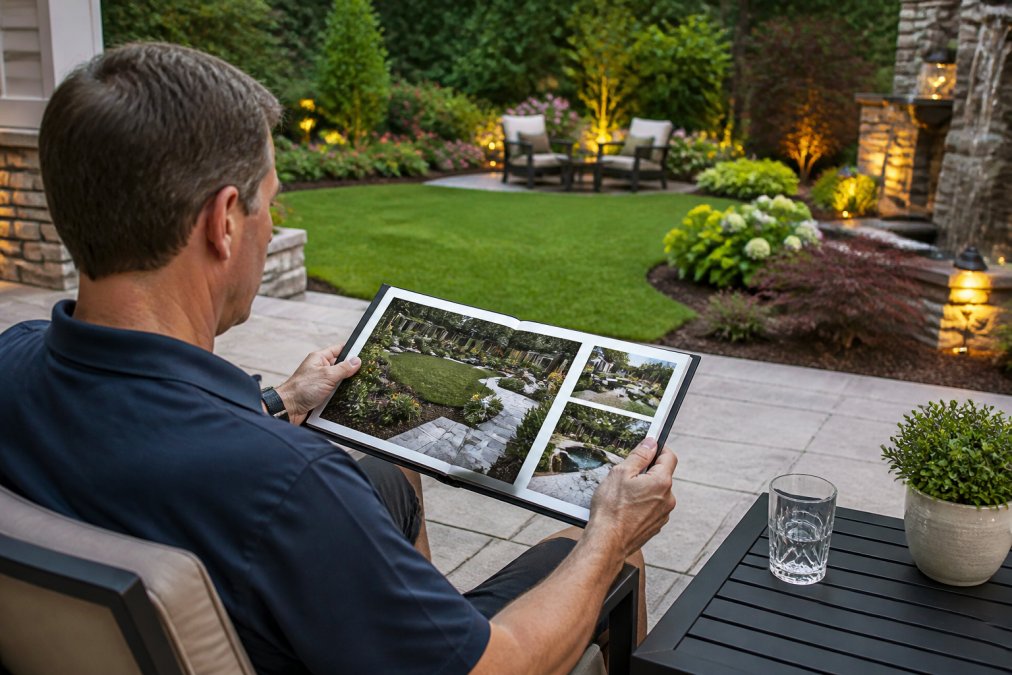
Ask the contractor for photos of completed projects similar to yours. Look at the quality of the hardscape work, are the edges clean? Do pavers or stone sit evenly? Look at planting design, is it well-balanced and thoughtful, or does it look generic? Pay attention to details like mulch quality, drainage solutions, and how well plants are spaced.
Request permission to visit completed projects in person if possible. Photos can be misleading. Seeing the work in person tells you whether it has held up over time and whether the contractor's attention to detail extends to things you won't see in a photo, like proper grading for drainage or sturdy construction underneath.
Call the references the contractor provides. Ask specific questions: Did the contractor finish on schedule? Were there unexpected costs? How was communication? Would you hire them again? Listen for hesitation or qualified answers, those matter as much as what they explicitly say.
Check online reviews on Google, Yelp, and the Better Business Bureau. Look for patterns in what people say. One negative review might be an outlier; multiple complaints about the same issue suggest a real problem. Pay special attention to reviews that mention specific issues, poor communication, unfinished work, surprise costs, rather than vague complaints.
Look at the contractor's social media presence and website. A well-maintained website and active social media presence suggest a professional, established business. A contractor who invests in their online presence is usually more invested in their reputation.
Creating Your Quote Verification Checklist
Use this checklist to ensure you've thoroughly evaluated each landscaping quote before making your decision. Print it out or create a digital copy and work through it for every contractor you're considering.
| Verification Step | Status | Notes |
|---|---|---|
| License verified in state database | ☐ | License #: _____ |
| Insurance and bonding confirmed | ☐ | Certificate provided: Yes/No |
| Written estimate received | ☐ | Itemized: Yes/No |
| Scope of work is detailed | ☐ | Includes: materials, labor, timeline |
| Payment schedule defined | ☐ | Deposit %: _____ |
| Warranty terms documented | ☐ | Workmanship: _____ Plant replacement: _____ |
| References contacted | ☐ | # of references called: _____ |
| Portfolio reviewed | ☐ | Similar projects: Yes/No |
| Online reviews checked | ☐ | Average rating: _____ |
| Red flags assessed | ☐ | Any concerns: _____ |
| Questions answered clearly | ☐ | Contractor responsive: Yes/No |
| Final decision made | ☐ | Contractor selected: _____ |
Walk through this checklist for each contractor. If you check "no" on any critical item, like license verification, insurance, or a detailed written estimate, that contractor shouldn't move forward. If you have concerns about any contractor, keep looking.
The goal of this process is to build confidence in your choice. When you've thoroughly verified a contractor's credentials, reviewed their work, and compared their quote to others, you're making an informed decision. That's the best protection against costly mistakes and the foundation for a successful landscaping project.
Verifying landscaping quotes takes time, but it's the most important step in hiring the right contractor. The extra effort upfront saves you from costly problems down the road. At Four Seasons Landscaping NY, we believe transparency and clear communication are essential, which is why we provide detailed, itemized estimates with no hidden fees and stand behind our work with solid warranties. Beyond landscaping design and installation, we also offer Holiday Lighting and Décor services to enhance your outdoor space year-round. When you're ready to move forward with confidence, get your free quote and experience the difference that professional, reliable service makes.
Frequently Asked Questions
What should be included in a professional landscaping quote?
A complete landscaping quote should include itemized labor costs, material specifications with quantities and grades, project timeline with start and completion dates, scope of work clearly defined, payment schedule, proof of insurance and bonding, contractor license number, and any warranty information. It should also specify whether permits are included and who is responsible for obtaining them. Avoid quotes that lump everything into a single line item without breakdown.
How do I know if a landscaping quote is realistic?
Compare quotes from at least three qualified contractors to establish a realistic price range. Unrealistically low bids often indicate the contractor is cutting corners, using inferior materials, or planning to add hidden change orders later. Verify that all quotes cover the same scope of work with similar material quality. Check if the contractor's timeline is reasonable for the project size. Request references from recent projects of similar complexity to validate their pricing and delivery.
Are landscaping contractors required to be licensed and insured?
Licensing requirements vary by state and local jurisdiction. Many states require landscape contractors to hold a license, while others only require licensing for specific services like pesticide application or electrical work. Insurance and bonding are not always legally mandated but are essential protections for you. Always request proof of general liability insurance and workers' compensation coverage. Verify the contractor's business legitimacy by checking with your state's regulatory board and consumer protection agency before signing any agreement.
What are the red flags to look for in a landscaping estimate?
Watch for quotes with no itemized breakdown, vague language about materials or methods, no written timeline or completion date, no proof of insurance or licensing, unusually low prices compared to other bids, pressure to pay the full amount upfront, no mention of permits or change order procedures, and reluctance to provide references. Be cautious of contractors who avoid putting terms in writing or who cannot clearly explain their scope of work. These signs often indicate inexperience, poor business practices, or intent to overcharge later.
This article was written using GrandRanker