 how-to
How to Avoid Hidden Landscaping Costs in 2026
Table of Contents
- Why Landscaping Quotes Balloon: The Real Sources of Hidden Costs
- Questions to Ask Landscaping Contractors Before You Sign
- What a Landscaping Contract Template Should Include
- Your Landscaping Site Preparation Checklist for Cost Control
- Understanding Landscaping Change Orders Before They Happen
- How to Avoid Hidden Landscaping Costs During Construction
- Frequently Asked Questions
Last Updated: September 11, 2026
Why Landscaping Quotes Balloon: The Real Sources of Hidden Costs
Learning how to avoid hidden landscaping costs starts with understanding where they come from. Most overruns trace back to the bidding stage, not the build. A vague quote leaves room for interpretation, and interpretation always favors the contractor's margin.
Three sources account for most surprises: undiscovered site conditions, allowances that get replaced with real selections, and change orders written after work begins.
- Undiscovered site conditions: rock, poor drainage, or buried debris nobody priced
- Allowance gaps: a placeholder number for materials that gets swapped for premium options
- Change orders: additions approved verbally, then billed at premium rates
The fix is not a cheaper contractor. It is a more specific document.
Questions to Ask Landscaping Contractors Before You Sign
The right questions to ask landscaping contractors force specificity before money changes hands. But questions alone are not enough. The gap most homeowners fall into is that they ask good questions, get reassuring answers, and never verify those answers against the written quote. The audit is what protects you.
Read the Quote Like an Auditor, Not a Customer
A landscaping quote is a scope document, not a price tag. Before you ask a single question, walk the quote line by line and sort every entry into one of three buckets:
- Defined work: a measurable task with a quantity and a unit (for example, "excavate 400 sq ft to 8 in depth, haul spoils off-site").
- Allowance: a placeholder dollar figure the contractor will spend on your behalf, usually for materials you have not selected yet.
- Exclusion: work the quote explicitly does not cover.
Most padding hides in the second and third buckets. An allowance is not a price; it is a promise to charge you later. An exclusion is not a discount; it is a cost that reappears on a future invoice.
The Five Questions That Expose a Vague Bid
- What is excluded from this quote? Disposal fees, utility locates, permit costs, and site restoration are the usual omissions. Ask for the exclusion list in writing, not verbally.
- How are allowances calculated, and what happens if we exceed them? Get the unit price in writing, per square foot, per linear foot, per plant, so you can compare the allowance against real market selections before you sign.
- What is your change order process and markup? Ask for the percentage before work starts, and ask whether the markup applies to labor, materials, or both.
- Who handles permits and inspections? If the answer is "you," budget the time and the fees, and confirm which inspections the contractor will still need to pass.
- What is the payment schedule tied to? Milestones, not calendar dates. A schedule tied to dates rewards a contractor for starting, not finishing.
How to Spot Padding in a Line Item
Padding rarely looks like an inflated number. It looks like a vague one. Watch for these patterns:
- Lump-sum line items that bundle excavation, base, and finish into one number with no quantities. You cannot audit what you cannot measure.
- "Mobilization" or "general conditions" charges that appear once and are never itemized. These are legitimate categories, but they should be a defined percentage or a defined scope, not a round number.
- Duplicate scope across two line items, for example, grading listed under both site prep and drainage.
- Unit prices that only appear in the allowance, not in the base bid, so overages are billed at a rate you never agreed to.
A bid that answers all five questions in writing, itemizes its quantities, and defines its allowances is a bid you can actually budget against. A bid that does not is a bid you are still negotiating after the first shovel moves.
FTC's guidance on home improvement contracts
What a Landscaping Contract Template Should Include
A landscaping contract template should spell out scope, materials, timeline, payment schedule, and change order terms. If any of those five elements is missing, you are signing an estimate, not a contract.
The scope section is where most disputes begin. "Install patio" means nothing. "Install 400 square feet of bluestone pavers over compacted base, including excavation to 8 inches and disposal of spoils" means everything.
Your template should also include:
- A materials list with grades and quantities
- A phased timeline with start and completion dates
- A payment schedule tied to completed milestones
- A written change order procedure with markup percentage
- Warranty terms for labor and plant health
The FTC's guidance on home improvement contracts outlines what consumers should expect in a written agreement, including a detailed description of the work and materials. Use that as your baseline, then add the site-specific detail your property requires.
Your Landscaping Site Preparation Checklist for Cost Control
A landscaping site preparation checklist prevents the single most expensive category of surprise: what is underground and what the ground itself will do to your design. Excavation, grading, and drainage work all depend on conditions nobody sees until the first shovel hits, and the cost of those conditions is set by your soil, your water table, and your climate, not by the contractor's hourly rate.
Site Survey, Utility Locates, and Soil Tests
Run these three steps before signing anything.
- Commission a site survey. A licensed surveyor documents grades, boundaries, and existing structures. This prevents retaining wall and drainage designs that fight the terrain, and a wall that fights the terrain is a wall that gets rebuilt.
- Call for utility locates. Buried gas, electric, and irrigation lines must be marked before excavation. Striking a line is a repair bill and a delay, and the repair is often billed at emergency rates.
- Test your soil. Soil type drives cost more than most homeowners expect. Clay holds water and expands, which means amended backfill, deeper drainage, and footing designs that account for movement. Sand drains fast but holds almost no nutrients, which means irrigation and soil amendment become ongoing line items rather than one-time ones.
| Pre-Build Step | What It Prevents | Who Arranges It |
|---|---|---|
| Site survey | Grading and boundary disputes | Licensed surveyor |
| Utility locates | Line strikes and repair bills | Utility company |
| Soil test | Plant failure, drainage rework | Soil testing lab |
| Drainage assessment | Standing water, foundation issues | Landscape contractor |
| Percolation check | Failed drainage design, rework | Soil testing lab or contractor |
The Site Conditions That Generate the Biggest Change Orders
These are the conditions that turn a fixed bid into an open invoice. Ask your contractor how the quote accounts for each one before you sign.
- Rock and buried debris. Excavation priced for soil becomes excavation priced for rock removal, which is a different operation with different equipment. Ask what the quote assumes about subsurface conditions and what happens if that assumption is wrong.
- High water table. A drainage system designed for surface water fails when groundwater rises. The fix is a different system, priced differently.
- Compacted or fill soil. New construction lots are often graded with compacted fill that will not drain. The remedy is amendment or replacement, and it is rarely in the base bid.
- Freeze-thaw movement. In regions with hard freeze-thaw cycles, improperly installed pavers crack and shallow footings heave. A quote that does not specify base depth and drainage for freeze-thaw conditions is a quote that will generate change orders in year two. Ask directly how the design accounts for it.
- Water restrictions and irrigation design. Local watering rules can limit what you are allowed to plant and how you are allowed to irrigate. A design that ignores them gets replanted at your expense.
Why Skipping These Steps Costs More, Not Less
Skipping these steps does not save money. It moves the cost to a later invoice with interest. A soil test that costs a few hundred dollars up front can prevent a drainage rework that costs several thousand later (peer-reviewed research). A utility locate that takes a phone call can prevent a repair bill and a multi-week delay. The pattern is consistent: the cheapest phase of a project is the one where you find out what you are actually building on.
Understanding Landscaping Change Orders Before They Happen
Understanding landscaping change orders means accepting that some are legitimate and some are avoidable. The legitimate ones come from conditions nobody could have predicted. The avoidable ones come from incomplete plans.
A change order is a written amendment to the original contract that adjusts scope, cost, or timeline. Every change order should state the work, the cost, and the schedule impact before anyone picks up a tool.
The best defense is a design complete enough that few changes are needed. Professional landscape design and architecture work done up front reduces mid-project pivots.
How to Avoid Hidden Landscaping Costs During Construction
To avoid hidden landscaping costs during construction, control the three things you still can: documentation, communication, and site access. The design is set. What happens next is project management.
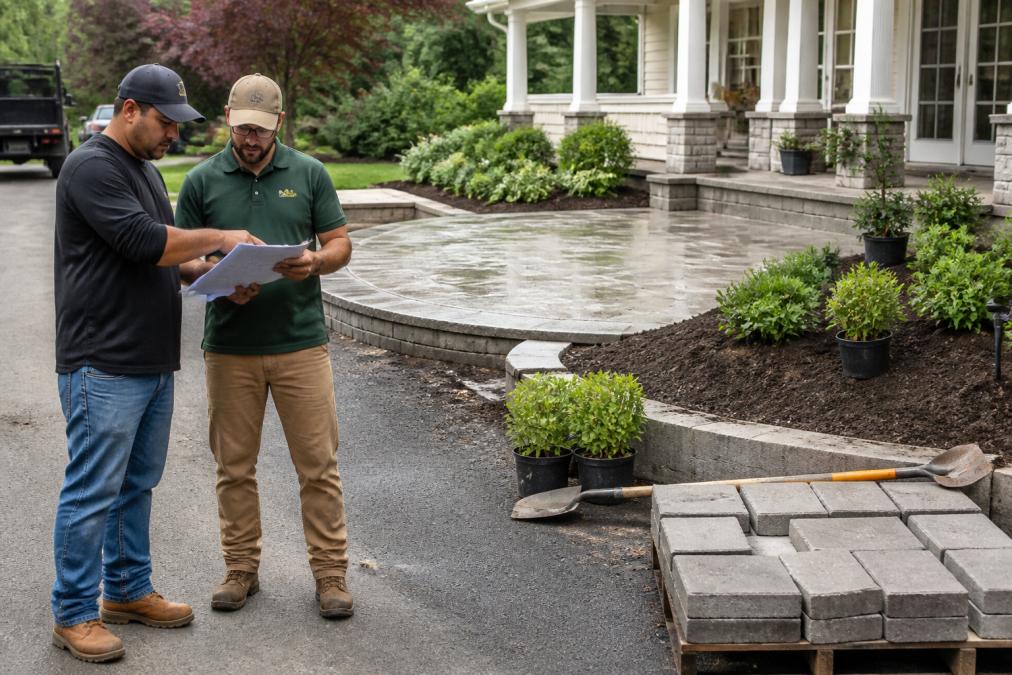
Keep a running log of every verbal instruction and follow up in writing the same day. Photograph the site before, during, and after each phase. Confirm material deliveries against the contract's materials list.
Post-installation costs deserve the same scrutiny. Irrigation installation, seasonal maintenance, and plant replacement are ongoing expenses, not one-time line items. Ask what the first year of upkeep looks like before the project closes.
Technology has changed this part of the equation. Irrigation controllers with soil-moisture sensors and weather-based scheduling cut water waste and reduce plant loss, which lowers long-term upkeep. Ask your contractor whether smart irrigation is part of the design.
One more angle most bids ignore: regional climate. Properties in this region face freeze-thaw cycles that crack improperly installed pavers and heave shallow footings for retaining walls. A quote that does not specify base depth and drainage for freeze-thaw conditions is a quote that will generate change orders in year two. Ask directly how the design accounts for it.
Phased landscaping is the other lever. Breaking a large project into stages spreads cost across seasons and lets you pause if the budget tightens. It also lets you see how the first phase performs before committing to the rest.
Hidden landscaping costs rarely come from dishonesty. They come from vague documents, unverified site conditions, and verbal approvals nobody wrote down. Control those three, and your project stays on budget.
If you would rather work with a team that puts scope, materials, and change order terms in writing before the first shovel moves, Four Seasons Landscaping NY has over 20 years of experience delivering transparent quotes and full-service outdoor solutions across Westchester County. From custom design and masonry to irrigation, year-round maintenance, and holiday lighting and décor, our fully insured professional crew handles it all.
Get your free quote from Four Seasons Landscaping NY and start your project with a plan you can actually budget against.
Frequently Asked Questions
What are the most common hidden costs in professional landscaping projects?
The biggest surprises come from site preparation, utility locates, soil amendment, drainage systems, and disposal fees. Excavation often uncovers rock or poor soil that was not visible during the initial walkthrough. Permitting fees and subcontractor charges for irrigation or masonry can also appear after the quote is signed. A detailed site survey and a written scope before work begins prevents most of these from becoming change orders.
Why do landscaping project costs often exceed the initial quote?
Quotes exceed expectations when the original bid was based on assumptions rather than a site survey. Missing utility locates, undiscovered drainage problems, or material substitutions can all trigger change orders. Seasonal pricing on plants and pavers, plus labor costs that shift with crew availability, add pressure. Asking for a line-item estimate and a contingency budget of 10 to 15 percent keeps the final number close to the original.
What should be included in a professional landscaping estimate?
A complete estimate lists labor costs, material markup, disposal fees, permitting fees, and any subcontractor fees separately. It should name the plants, hardscaping materials, and irrigation components by type and quantity. Ask whether site grading, soil amendment, and mulching are included or billed separately. If the estimate is one lump sum with no breakdown, request a revised version before signing.
How can I ensure my landscaping contract is comprehensive?
Use a landscaping contract template that covers scope of work, payment schedule, change order procedures, timeline, and warranty terms. Include who handles permits, utility locates, and waste management. Specify how disputes are resolved and what happens if the crew damages irrigation or lighting lines. A contract that addresses these items protects both you and the contractor and removes the ambiguity that leads to surprise fees.