 listicle
Commercial Landscaping Services White Plains: 2026 Guide
Table of Contents
- What Commercial Landscaping Services Cover for White Plains Properties
- How Commercial Landscape Maintenance Contracts Work
- The ROI of Professional Commercial Landscaping
- Commercial Snow and Ice Management: Keeping Properties Safe
- Holiday Lighting Installation for Commercial Properties
- Sustainable Landscaping Practices for Commercial Grounds
- How to Choose the Right Commercial Landscaping Services Provider
- Conclusion
Last Updated: August 29, 2026
Commercial property owners who underinvest in their grounds pay twice: once in lost curb appeal, and again in tenant turnover, slower lease-up rates, and liability exposure. At Four Seasons Landscaping NY, we've spent over 20 years maintaining commercial properties across Westchester County. Well-maintained exteriors attract better tenants, command stronger rents, and require fewer emergency repairs. This guide covers everything property managers need to know about commercial landscaping services, from full-service maintenance to snow management, sustainable practices, and seasonal enhancements like holiday lighting and décor.
What Commercial Landscaping Services Cover for White Plains Properties
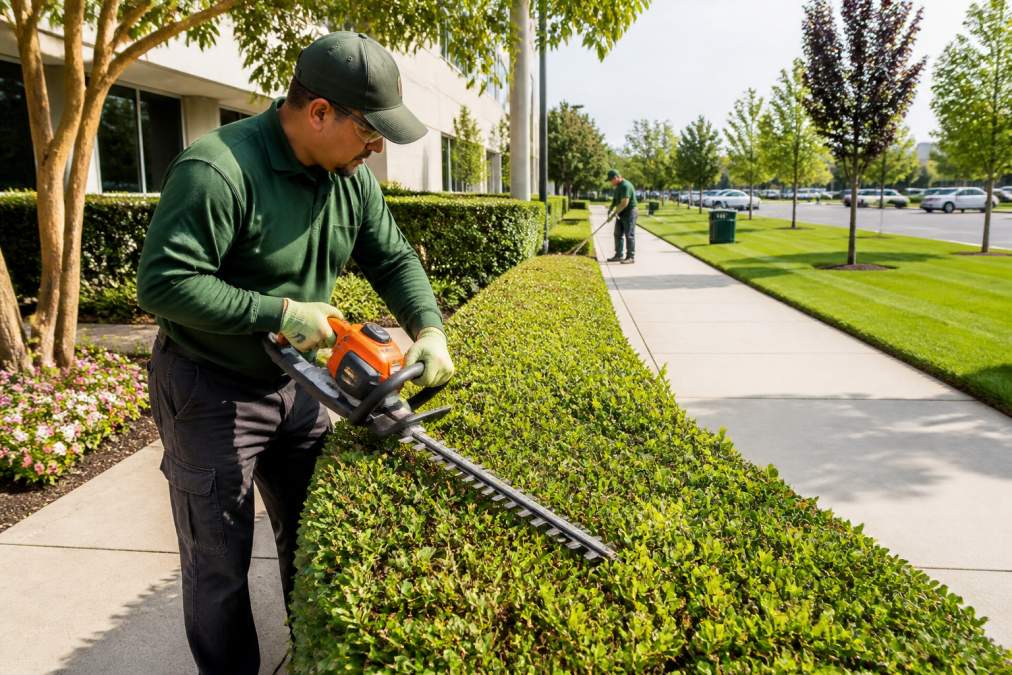
Commercial landscaping services are the full range of grounds maintenance, design, and installation work performed on business properties to preserve safety, aesthetics, and property value. Professional grounds maintenance treats the property as a system: turf care, tree health monitoring, hardscape upkeep, irrigation management, and seasonal transitions are all interconnected. Skipping regular pruning creates liability exposure. Ignoring irrigation inefficiencies drives up water costs. Letting turf thin out invites weed pressure that compounds each season.
Lawn Care and Turf Management
Turf management on commercial property differs from residential lawn care. High-traffic areas compact soil faster, requiring aeration schedules that match actual use patterns. A complete program includes mowing at correct height for the grass species and season, edging along walkways and planting beds, core aeration to relieve compaction, overseeding thin areas, fertilization and weed control tied to soil conditions, and seasonal debris cleanup. The difference between a maintained lawn and a thriving one comes down to consistency. Irregular service intervals allow weeds to establish and turf to thin, creating compounding problems that cost significantly more to correct than to prevent.
Tree Care, Pruning, and Plant Health
Tree care is where deferred maintenance creates real liability. Overhanging branches, dead wood, and root systems encroaching on hardscape are documented sources of property damage and personal injury claims. According to the International Society of Arboriculture's tree care guidelines, routine pruning extends tree lifespan, reduces storm damage risk, and maintains structural integrity near buildings and walkways. Plant health care programs that monitor for pest pressure, disease, and nutrient deficiencies catch problems early when they're inexpensive to address.
Hardscaping, Irrigation, and Drainage Solutions
Hardscaping covers non-plant elements: walkways, patios, retaining walls, and entrance features. These surfaces require periodic inspection to prevent cracking, heaving from freeze-thaw cycles, and drainage failures that redirect water toward building foundations. Irrigation system installation and repair is closely tied to turf health and water management compliance. Many commercial properties operate aging systems that waste water through inefficient scheduling or broken heads. Upgrading to smart controllers and properly zoned drip systems reduces water use while improving plant health. Proper drainage protects the entire investment by preventing hardscape deterioration, standing water liability, and plant stress.
How Commercial Landscape Maintenance Contracts Work
A commercial landscape maintenance contract is a formal service agreement that defines scope, schedule, and terms of ongoing grounds care. The best contracts are specific enough to prevent disputes and flexible enough to accommodate seasonal needs.
What a Full-Service Contract Typically Includes
Full-service contracts generally cover turf management, seasonal cleanups, pruning, irrigation startup and winterization, mulching, and fertilization programs. Some providers bundle snow and ice management into year-round agreements; others price it separately. Key elements to look for include defined visit frequency, scope of each visit, response time for issues, change order process, and termination and renewal terms. Transparent pricing is non-negotiable. Contractors who provide vague scope language and then issue change orders for work that should have been included are a common complaint.
Customized Maintenance Schedules vs. One-Size-Fits-All Plans
The biggest difference between a professional provider and a commodity service is whether the maintenance schedule is built around your property or their routing efficiency. One-size-fits-all plans apply the same visit frequency and service sequence to every property in a route, producing mediocre results for complex sites. Customized schedules account for property-specific turf varieties, planting bed complexity, high-traffic areas, seasonal priorities, and tenant-facing areas requiring higher presentation standards.
| Schedule Type | Best For | Key Advantage | Main Limitation |
|---|---|---|---|
| Customized plan | High-visibility, complex properties | Matches actual site needs | Requires detailed site assessment upfront |
| Standard plan | Simple, low-complexity sites | Predictable, easy to budget | May over- or under-service specific areas |
| Hybrid plan | Mid-complexity properties | Flexible core with add-ons | Requires clear scope boundaries |
The ROI of Professional Commercial Landscaping
Professional commercial landscaping generates measurable returns across property value, tenant retention, and liability reduction. According to research by the American Society of Landscape Architects, well-designed and maintained commercial landscapes consistently contribute to higher property valuations and faster lease-up rates. Overgrown trees, uneven hardscape, and icy walkways are among the most common sources of premises liability claims. Proactive grounds maintenance with documented inspection and service records creates a defensible record of due diligence. Curb appeal directly affects tenant and customer behavior, a well-maintained exterior signals operational competence, while properties that let grounds maintenance lapse see tenant satisfaction drop and become harder to lease at competitive rates.
Commercial Snow and Ice Management: Keeping Properties Safe
Commercial snow and ice management requires planning before the first storm, not after it. Properties that scramble to find plowing contractors in December consistently pay more and receive worse service than those with pre-season agreements. A complete program covers pre-treatment with ice melt before storm events, plowing of parking areas and access roads, sidewalk clearing to maintain ADA-compliant pedestrian access, salt and sand application for traction, and post-storm cleanup. The Occupational Safety and Health Administration's guidelines on walking-working surfaces establish clear employer obligations for maintaining safe pedestrian access on commercial properties. Documented snow removal service records are essential if a slip-and-fall claim is ever filed. Timing matters as much as scope, a provider who arrives six hours after a storm has left your property exposed during the highest-risk window.
Holiday Lighting and Décor for Commercial Properties
Holiday lighting and décor installation is one of the fastest-growing categories in commercial landscaping services, and the window to get on a provider's calendar is shorter than most property managers expect. Providers who do this work well are typically booked weeks in advance, with the best installation slots going to returning clients and early-booking new accounts.
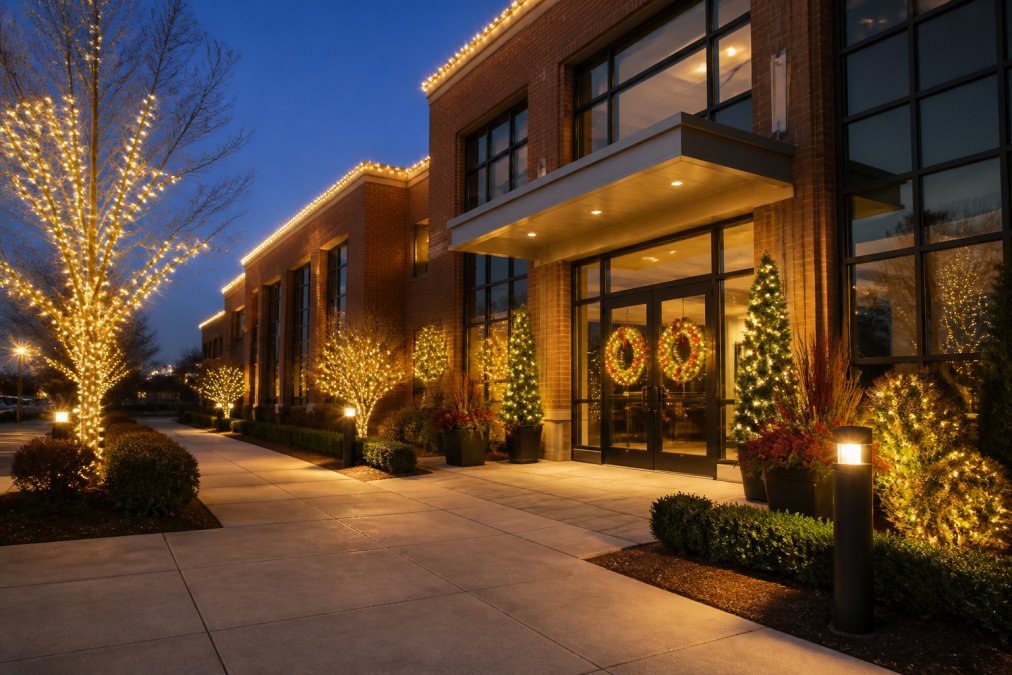
Professional holiday lighting and décor goes well beyond stringing lights on a tree. A complete program includes design, installation, maintenance during the display period, and full removal and storage after the season. Commercial-grade lighting systems require proper mounting hardware, weatherproof connections, and load calculations that DIY installations routinely skip. For retail properties, office parks, and hospitality venues, the exterior lighting display is a direct extension of the brand. Warm white LED roofline lighting, illuminated entrance features, and professionally installed wreaths and garlands create an atmosphere that attracts foot traffic and signals that the business is active and invested in its presentation.
What to confirm before booking a commercial holiday lighting and décor installation:
- Custom design that fits the property's architecture and brand aesthetic
- Commercial-grade LED fixtures rated for outdoor use
- Proper electrical load assessment before installation
- Scheduled maintenance visits during the display period
- Guaranteed removal by a specified date after the season
- Storage of fixtures for reuse in subsequent seasons
Four Seasons Landscaping NY handles the full cycle: design, installation, in-season maintenance, and post-season removal. If you want your property on the calendar for this season, the time to schedule is now.
Sustainable Landscaping Practices for Commercial Grounds
Sustainable landscaping is no longer niche. Many commercial tenants now include grounds sustainability in vendor selection criteria, and municipal water use regulations in Westchester County have made efficient irrigation a practical necessity. According to the EPA's WaterSense program for commercial irrigation, commercial irrigation accounts for significant water consumption in developed areas, and smart irrigation controllers can substantially reduce outdoor water use compared to conventional timer-based systems. Sustainable practices include native and adaptive plantings that require less supplemental irrigation, smart irrigation controllers that adjust schedules based on weather data and soil moisture sensors, organic and low-input fertilization programs, integrated pest management prioritizing non-chemical interventions, permeable hardscape materials allowing stormwater infiltration, and mulching programs that conserve soil moisture and suppress weeds. Sustainable landscape design is also good long-term economics, native plantings require less maintenance over time, efficient irrigation reduces utility costs, and reduced chemical applications lower input costs and regulatory exposure.
How to Choose the Right Commercial Landscaping Services Provider
Choosing a commercial landscaping provider is a procurement decision deserving the same rigor as any other significant vendor relationship. The wrong choice costs more than the contract value in emergency repairs, liability exposure, and time managing underperformance.
Questions to Ask Before Signing a Contract
- How long have you been servicing commercial properties of this size and type? Experience with residential landscaping does not translate directly to commercial grounds management.
- Are you fully insured, and can you provide a certificate of insurance? General liability and workers' compensation coverage are non-negotiable.
- Who will be the consistent point of contact for our account? Providers who rotate crews without dedicated account management create communication gaps.
- How do you handle service issues between scheduled visits? The answer reveals whether they have real service infrastructure.
- Can you provide references from commercial properties with similar scope? A strong provider will have no hesitation.
- What does your change order process look like? This is where pricing transparency either holds up or falls apart.
Red Flags That Signal the Wrong Provider
A common mistake is selecting a provider based on the lowest bid without examining what that bid covers. Low bids typically reflect reduced visit frequency, lower-grade materials, or scope exclusions that surface as change orders later. Watch for vague scope language in proposals, no written confirmation of visit schedules, reluctance to provide insurance certificates or references, no dedicated account manager, pressure to sign quickly, and no documented process for handling service complaints. The cheapest provider almost never delivers the lowest total cost of ownership.
| Evaluation Criterion | What to Look For | Red Flag |
|---|---|---|
| Experience | Commercial properties, similar scope | Residential-only portfolio |
| Insurance | Certificate on request, current coverage | Delays or refusals |
| Contract clarity | Line-item scope, defined visit frequency | Vague "as needed" language |
| References | Commercial clients, similar property type | Unable to provide references |
| Account management | Named contact, clear escalation path | No dedicated contact |
| Pricing transparency | Itemized quote, defined change order process | Bundled pricing only |
Maintaining a commercial property's exterior is a year-round commitment that affects asset value, tenant satisfaction, and legal exposure. Four Seasons Landscaping NY provides full-service commercial landscaping across Westchester County, backed by 20+ years of experience, a fully insured professional crew, and transparent quoting with no hidden fees. Whether you need comprehensive maintenance, commercial snow and ice management, or holiday lighting and décor before the season books up, we handle it all under one roof. Get your free quote and secure your spot on the calendar.
Frequently Asked Questions
Q: What services are typically included in a commercial landscaping contract?
A: Most commercial landscaping contracts cover regular lawn mowing and turf management, fertilization, weed control, mulching, seasonal cleanups, pruning, and irrigation system checks. Full-service providers like Four Seasons Landscaping NY also offer snow and ice management, hardscaping upkeep, and holiday lighting installation, so property managers deal with one company rather than coordinating multiple contractors across the year.
Q: What is the difference between commercial and residential landscaping?
A: Commercial landscaping focuses on business exteriors, office parks, retail centers, and multi-tenant properties where consistent curb appeal, liability management, and compliance with local codes matter most. Crews typically work on larger footprints, follow tighter schedules to avoid disrupting business hours, and carry commercial-grade insurance. Residential landscaping centers on individual homeowner preferences and more flexible scheduling.
Q: How does professional landscaping impact commercial property value?
A: A well-maintained business exterior signals to tenants, customers, and investors that a property is professionally managed. Strong curb appeal reduces vacancy rates, supports higher lease rates, and can shorten the time a property sits on the market. Consistent groundskeeping, healthy plantings, and clean hardscaping also reduce long-term repair costs by catching drainage issues and structural problems early.
Q: Why is year-round landscaping maintenance important for businesses?
A: Gaps in maintenance compound quickly. Overgrown turf, icy walkways, and neglected plantings all create liability exposure and hurt first impressions. A year-round commercial landscape maintenance contract keeps the property in peak condition across every season, from spring fertilization and summer irrigation checks to fall cleanup, winter snow and ice management, and holiday lighting installation for commercial properties.
Q: How do I choose the best commercial landscaping company for my business?
A: Prioritize companies that carry full commercial insurance, offer transparent written contracts with no hidden fees, and have verifiable experience with properties similar to yours. Ask for a site assessment before signing anything. Providers who offer customized maintenance schedules rather than generic plans tend to deliver better results. Check that they handle every service you need, from turf care to snow removal, so you are not managing multiple vendors.
This article was written using GrandRanker