 ultimate-guide
Landscape Project Scheduling and Reliability That Works
Table of Contents
- What Landscape Project Scheduling and Reliability Actually Require
- How to Avoid Landscape Project Delays Before the First Shovel Hits Soil
- Landscape Construction Timeline Expectations by Project Type
- Landscape Project Management Software: What It Can and Cannot Fix
- Reliability Metrics That Show Whether a Schedule Is Holding
- Crew Management, Labor Tracking, and Daily Field Operations
- Frequently Asked Questions
Last Updated: September 23, 2026
What Landscape Project Scheduling and Reliability Actually Require
Landscape project scheduling means sequencing design, permitting, site prep, installation, and planting against real crew capacity and material availability, then tracking daily progress. Reliability is harder: doing it the same way on job 40 as on job one.
How to Avoid Landscape Project Delays Before the First Shovel Hits Soil
The most effective way to avoid landscape project delays is to resolve three drivers before mobilization: weather exposure, procurement timing, and permit and design approval. Projects that address all three finish closer to their original dates.
Weather Contingency Planning for Outdoor Work
Weather contingency planning means reserving slack days for rain, frost, and extreme heat rather than hoping for a clear stretch. The common mistake is treating weather as an after-the-fact excuse instead of a line item before work starts.
Practical approach:
- Build buffer days into the wettest and coldest months rather than spreading them evenly
- Sequence work so at least one task can proceed in poor conditions, such as shop fabrication or material staging
- Track local frost dates and soil temperature thresholds before scheduling planting and hardscape base work
- Set a written stand-down threshold, so the call is not made on the truck at 6 a.m.
Material Lead Times and Procurement Buffers
Material lead times and procurement buffers determine whether a schedule survives contact with reality. Natural stone, custom masonry units, specimen plantings, and irrigation components often ship on timelines the client never sees, and one late delivery can stall an entire phase.
The fix is to schedule procurement backward from the install date, not forward from the order date:
- Confirm lead times in writing at the bid stage
- Order long-lead items before demolition begins
- Stage materials on site early when the property allows, so weather does not compound a supplier delay
- Keep a documented substitution list so a backordered item does not stop the job
Landscape Construction Timeline Expectations by Project Type
Landscape construction timeline expectations vary widely by scope, and setting them accurately at the outset prevents most mid-project disputes. A planting refresh and a full property build are not the same project, and treating them as one category is where expectations drift.
| Project Type | Typical Duration | Main Schedule Risk | Buffer Needed |
|---|---|---|---|
| Planting and bed refresh | 1-3 days | Plant availability | Minimal |
| Irrigation system install | 3-7 days | Trenching weather, permits | Moderate |
| Paver patio or walkway | 1-3 weeks | Base prep, stone lead time | Moderate |
| Retaining wall and masonry | 2-5 weeks | Frost depth, unit lead time | High |
| Full property design and build | 6-16 weeks | Sequencing across trades | High |
Landscape Project Management Software: What It Can and Cannot Fix
Landscape project management software fixes coordination and visibility. It does not fix an unrealistic schedule, an understaffed crew, or a supplier who cannot deliver. Teams expecting software to solve a planning problem end up with a well-documented delay.
What Each Category of Tool Actually Solves
- Field service and crew scheduling platforms (where most landscape companies start) handle dispatch, crew assignment, mobile time clock, and client-facing schedule views. Strongest when your bottleneck is knowing who is where.
- Construction project management platforms handle multi-phase sequencing, submittals, RFIs, and change orders. Strongest on larger design-build properties where trades overlap and the schedule has dependencies, not just tasks.
- Accounting and job-costing systems handle phase-level labor and material posting, progress invoicing, and margin tracking. Strongest when your bottleneck is knowing whether the job actually makes money.
- Procurement and material tracking tools, even a shared spreadsheet with lead-time columns, handle order dates, confirmed ship dates, and substitution lists. Most landscape companies skip this category, yet it most often determines whether the schedule holds.
What Software Genuinely Improves
- Real-time visibility into task completion across multiple crews and properties
- Job costing that updates as labor and materials are logged against a phase
- Client communication through a shared schedule view, which reduces 'when are you coming back' calls
- Invoicing tied to completed milestones rather than calendar dates
- A searchable record of what actually happened, the raw material for better estimates next season
What Software Cannot Do
- Predict a two-week stone backorder you never confirmed in writing
- Replace a foreman's judgment about whether soil is workable after three inches of rain
- Create capacity that is not on the payroll
- Fix a schedule built backward from a client's party date instead of forward from site conditions
- Reconcile two crews logging hours against the same phase under different names
The Procurement Gap Most Software Leaves Open
Here is the part almost no ranking guide covers: material lead time is a scheduling input, not a purchasing afterthought. A single late delivery can stall an entire phase regardless of how clean your Gantt chart looks.
- At the bid stage, confirm lead times in writing for every long-lead item.
- Build the schedule backward from the install date, not forward from the order date.
- Enter confirmed ship dates into your scheduling tool as dependencies, so a slip automatically pushes downstream tasks instead of being discovered on the truck.
- Maintain a documented substitution list so a backordered item does not stop the job while you wait for approval.
- Stage materials on site early when the property allows, so weather does not compound a supplier delay.
Reliability Metrics That Show Whether a Schedule Is Holding
Reliability metrics are the only honest way to know whether your scheduling process works or you have simply been lucky. Most landscape scheduling guides skip this entirely, they tell you which software to buy and never how to prove the schedule is holding.
The Four Core Reliability Metrics
1. Schedule variance (SV) Formula: planned completion date minus actual completion date, measured per phase, not per project. A patio finishing three days late is a data point; paver phases averaging four days late is a pattern. Track it by phase type to see whether the slip lives in base prep, masonry, or planting.
How to Read the Numbers Together
No single metric tells the story. The combinations do:
- Low schedule variance + high milestone hit rate = genuinely reliable. This is the target state.
- Low schedule variance + low milestone hit rate = the milestones keep moving. The schedule is not holding; it is being rewritten to look like it is.
- High schedule variance + high rework rate = the crew is compressing work to catch up, and quality is paying for it.
- High labor productivity + high rework rate = the crew is moving fast and doing it twice. Speed without quality is not productivity.
A Practical Tracking Cadence
- Daily: foreman logs hours against the specific phase, not the whole job, and flags any slip the same day.
- Weekly: office reviews schedule variance and productivity against the plan and updates the milestone list.
- Monthly: review rework rate and milestone hit rate across all active projects to spot patterns by phase type or crew.
- Seasonally: compare this season's averages to last season's to see whether the process is improving or just feeling busier.
What 'Good' Looks Like
There is no universal benchmark, because reliability is relative to your own baseline. What matters is direction and consistency: milestone hit rate trending up quarter over quarter, schedule variance trending toward zero, and rework rate flat or falling as volume grows. A company that can show a client or general contractor a documented milestone hit rate gets invited back to bigger projects.
Crew Management, Labor Tracking, and Daily Field Operations
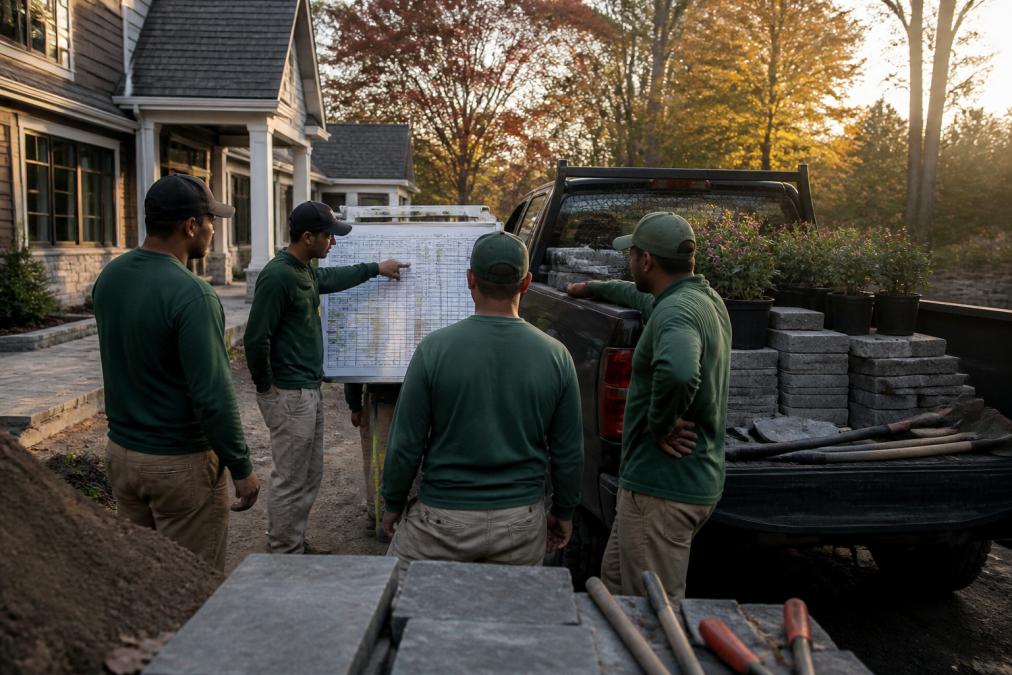
Crew management and labor tracking decide whether the schedule on paper survives the week. Resource allocation across multiple properties is the most common operational bottleneck for growing landscape companies, because every crew reassignment ripples through two or three other job timelines.
What holds up in practice:
- Assign crews to a consistent property type so productivity benchmarks stay comparable
- Log labor hours daily against the specific phase, not the job as a whole
- Track resource use weekly to spot crews running under or over capacity
- Give the foreman authority to flag a schedule slip the same day, before it compounds
Frequently Asked Questions
What should be included in a professional landscape project schedule?
A working schedule lists every phase in order: design sign-off, permits, demolition, hardscape installation, planting, irrigation, and cleanup. Each phase needs a start date, duration, crew assignment, and material delivery window. It should also name the client decision points, such as plant selection or lighting layout, because late approvals are one of the most common causes of slippage. Ask for the schedule in writing before work begins, and confirm who updates it when conditions change.
How do professional landscapers manage project timelines?
They build the timeline backward from a completion date, then add buffer days for weather and material delays. Crews are assigned by skill, with hardscape and irrigation work sequenced so trades do not block each other. Daily field reports and photos keep the office informed, and any schedule variance gets communicated to the client the same week it appears. Software helps track this, but the discipline of updating it daily matters more than the tool itself.
How do weather conditions impact landscape project reliability?
Rain delays excavation, masonry, and paving because wet subgrades do not compact properly. Frozen ground stops planting and irrigation installation entirely. Reliable contractors plan around this by front-loading drainage and grading work, scheduling plantings inside the appropriate growing window, and holding contingency days in the schedule. In colder months, snow management obligations can also pull crews off construction, so ask how winter service commitments affect your project timeline before signing.
What are the benefits of using landscape project management software?
Software centralizes job scheduling, task tracking, crew assignments, and job costing in one place, which reduces the phone calls and spreadsheet errors that cause missed appointments. Real-time monitoring lets an office spot a slipping phase before it cascades into the next one, and invoicing integration ties completed milestones to billing. The main benefit is visibility: clients and crews see the same schedule. The limitation is that software only reflects what someone enters, so daily updates are essential.